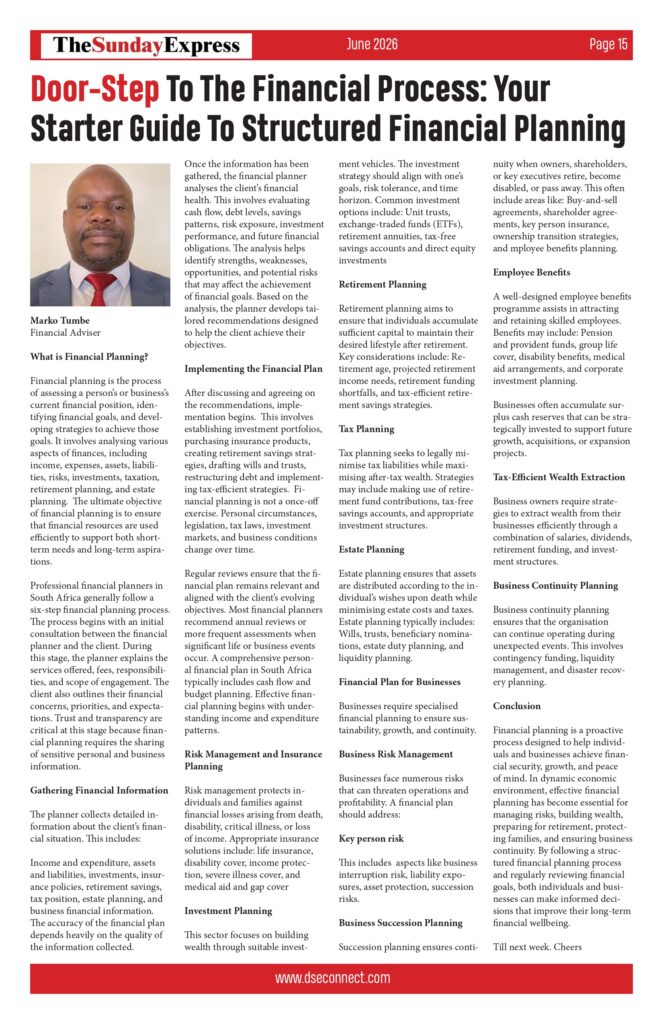
Marko Tumbe
Financial Adviser
What is Financial Planning?
Financial planning is the process of assessing a person’s or business’s current financial position, identifying financial goals, and developing strategies to achieve those goals. It involves analysing various aspects of finances, including income, expenses, assets, liabilities, risks, investments, taxation, retirement planning, and estate planning.
The ultimate objective of financial planning is to ensure that financial resources are used efficiently to support both short-term needs and long-term aspirations.
The Financial Planning Process
Professional financial planners in South Africa generally follow a six-step financial planning process.
- Establishing the Client Relationship
The process begins with an initial consultation between the financial planner and the client. During this stage, the planner explains the services offered, fees, responsibilities, and scope of engagement. The client also outlines their financial concerns, priorities, and expectations.
Trust and transparency are critical at this stage because financial planning requires the sharing of sensitive personal and business information. - Gathering Financial Information
The planner collects detailed information about the client’s financial situation. This includes:
Income and expenditure
Assets and liabilities
Existing investments
Insurance policies
Retirement savings
Tax position
Estate planning documents
Business financial information (where applicable)
The accuracy of the financial plan depends heavily on the quality of the information collected. - Analysing the Financial Position
Once the information has been gathered, the financial planner analyses the client’s financial health. This involves evaluating cash flow, debt levels, savings patterns, risk exposure, investment performance, and future financial obligations.
The analysis helps identify strengths, weaknesses, opportunities, and potential risks that may affect the achievement of financial goals. - Developing Financial Planning Recommendations
Based on the analysis, the planner develops tailored recommendations designed to help the client achieve their objectives. These recommendations consider the client’s risk tolerance, investment horizon, financial capacity, and personal circumstances.
The recommendations are documented in a comprehensive financial plan. - Implementing the Financial Plan
After discussing and agreeing on the recommendations, implementation begins. This may involve:
Establishing investment portfolios
Purchasing insurance products
Creating retirement savings strategies
Drafting wills and trusts
Restructuring debt
Implementing tax-efficient strategies
The financial planner often coordinates with attorneys, tax practitioners, investment managers, and other professionals during this phase. - Monitoring and Reviewing the Plan
Financial planning is not a once-off exercise. Personal circumstances, legislation, tax laws, investment markets, and business conditions change over time.
Regular reviews ensure that the financial plan remains relevant and aligned with the client’s evolving objectives. Most financial planners recommend annual reviews or more frequent assessments when significant life or business events occur.
Components of a Financial Plan for Individuals
A comprehensive personal financial plan in South Africa typically includes the following components:
Cash Flow and Budget Planning
Effective financial planning begins with understanding income and expenditure patterns. Budgeting helps individuals control spending, reduce financial stress, and increase savings.
Risk Management and Insurance Planning
Risk management protects individuals and families against financial losses arising from death, disability, critical illness, or loss of income.
Appropriate insurance solutions may include:
Life insurance
Disability cover
Income protection
Severe illness cover
Medical aid and gap cover
Investment Planning
Investment planning focuses on building wealth through suitable investment vehicles.
The investment strategy should align with one’s goals, risk tolerance, and time horizon.
Common investment options in South Africa include:
Unit trusts
Exchange-traded funds (ETFs)
Retirement annuities
Tax-free savings accounts
Direct equity investments
Retirement Planning
Retirement planning aims to ensure that individuals accumulate sufficient capital to maintain their desired lifestyle after retirement.
Key considerations include:
Retirement age
Projected retirement income needs
Retirement funding shortfalls
Tax-efficient retirement savings strategies
Tax Planning
Tax planning seeks to legally minimise tax liabilities while maximising after-tax wealth. Strategies may include making use of retirement fund contributions, tax-free savings accounts, and appropriate investment structures.
Estate Planning
Estate planning ensures that assets are distributed according to the individual’s wishes upon death while minimising estate costs and taxes.
Estate planning typically includes:
Wills
Trusts
Beneficiary nominations
Estate duty planning
Liquidity planning
Components of a Financial Plan for Businesses
Businesses require specialised financial planning to ensure sustainability, growth, and continuity.
Business Risk Management
Businesses face numerous risks that can threaten operations and profitability. A financial plan should address:
Key person risk
Business interruption risk
Liability exposures
Asset protection
Succession risks
Business Succession Planning
Succession planning ensures continuity when owners, shareholders, or key executives retire, become disabled, or pass away.
This often includes:
Buy-and-sell agreements
Shareholder agreements
Key person insurance
Ownership transition strategies
Employee Benefits Planning
A well-designed employee benefits programme assists in attracting and retaining skilled employees.
Benefits may include:
Pension and provident funds
Group life cover
Disability benefits
Medical aid arrangements
Corporate Investment Planning
Businesses often accumulate surplus cash reserves that can be strategically invested to support future growth, acquisitions, or expansion projects.
Tax-Efficient Wealth Extraction
Business owners require strategies to extract wealth from their businesses efficiently through a combination of salaries, dividends, retirement funding, and investment structures.
Business Continuity Planning
Business continuity planning ensures that the organisation can continue operating during unexpected events. This involves contingency funding, liquidity management, and disaster recovery planning.
Conclusion
Financial planning is a proactive process designed to help individuals and businesses achieve financial security, growth, and peace of mind.
In South Africa’s dynamic economic environment, effective financial planning has become essential for managing risks, building wealth, preparing for retirement, protecting families, and ensuring business continuity.
By following a structured financial planning process and regularly reviewing financial goals, both individuals and businesses can make informed decisions that improve their long-term financial wellbeing.
Till Next Week. Cheers