DSE News Network: Technology
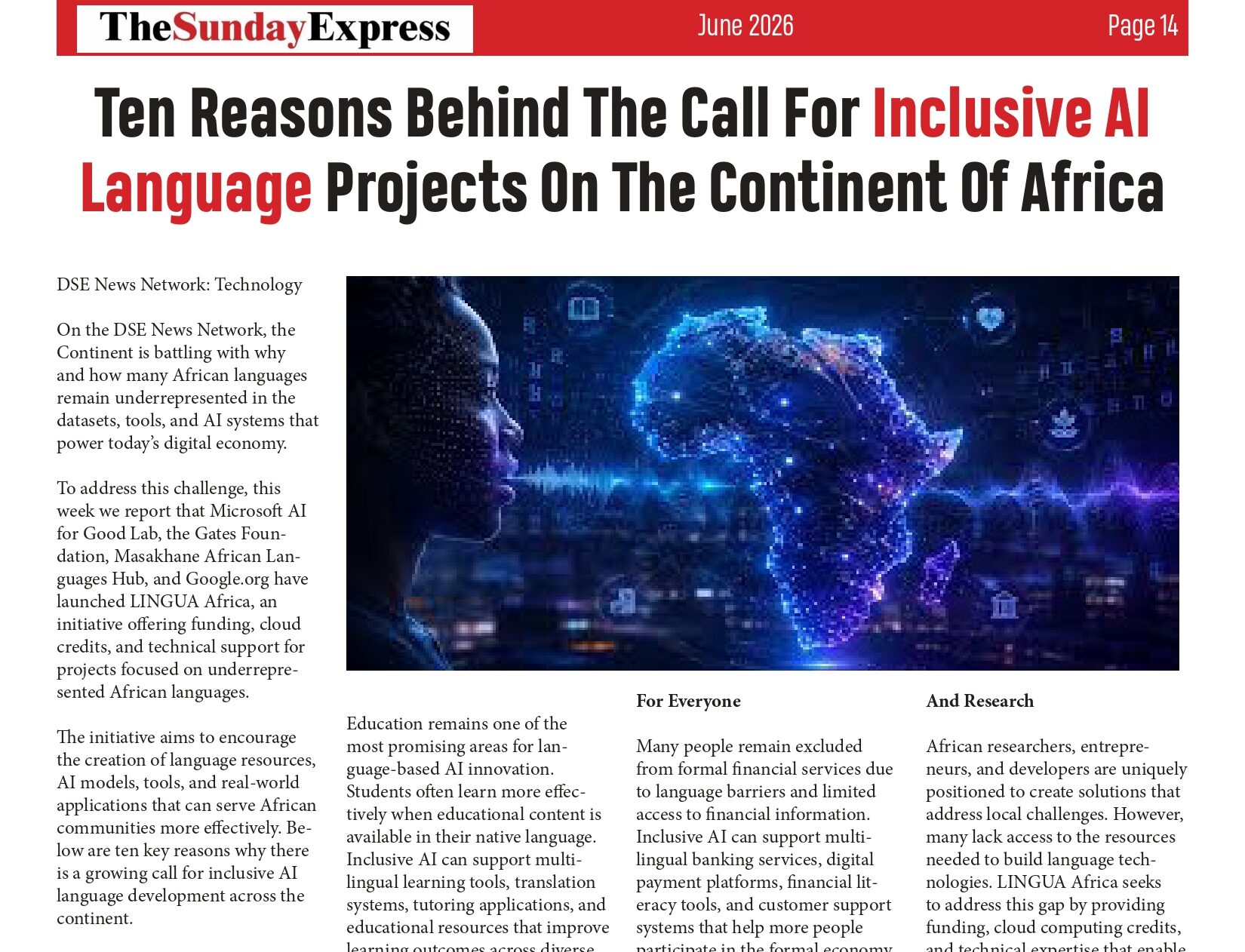
On the DSE News Network, the Continent is battling with why and how many African languages remain underrepresented in the datasets, tools, and AI systems that power today’s digital economy.
To address this challenge, this week we report that Microsoft AI for Good Lab, the Gates Foundation, Masakhane African Languages Hub, and Google.org have launched LINGUA Africa, an initiative offering funding, cloud credits, and technical support for projects focused on underrepresented African languages.
The initiative aims to encourage the creation of language resources, AI models, tools, and real-world applications that can serve African communities more effectively. Below are ten key reasons why there is a growing call for inclusive AI language development across the continent.
1 Preserve Africa’s Linguistic Diversity Today
Africa is home to more than 2,000 languages, representing one of the world’s richest linguistic landscapes. Many of these languages face the risk of digital exclusion because they lack sufficient online content and language resources. Inclusive AI projects can help preserve linguistic heritage by creating datasets, speech recordings, translations, and digital tools that ensure African languages remain relevant in the digital age.
2 Expand Access To Digital Services
Millions of Africans are unable to fully benefit from digital services because many platforms operate primarily in global languages such as English, French, or Portuguese. AI systems that understand local languages can make digital services more accessible, allowing people to interact with technology in the language they know best.
3 Improve Educational Outcomes Across Communities
Education remains one of the most promising areas for language-based AI innovation. Students often learn more effectively when educational content is available in their native language. Inclusive AI can support multilingual learning tools, translation systems, tutoring applications, and educational resources that improve learning outcomes across diverse communities.
4 Strengthen Healthcare Communication And Access
Healthcare information can be difficult to understand when it is delivered in unfamiliar languages. AI-powered translation tools, voice assistants, and health information systems can help patients access critical healthcare guidance in their preferred language. This can improve understanding, increase trust, and support better health outcomes.
5 Support Farmers With Local Knowledge
Agriculture remains a major source of livelihood across Africa. Farmers frequently need timely information about weather conditions, crop diseases, market prices, and farming techniques. AI tools that communicate in local languages can help farmers receive practical advice and make informed decisions that improve productivity and food security.
6 Promote Financial Inclusion For Everyone
Many people remain excluded from formal financial services due to language barriers and limited access to financial information. Inclusive AI can support multilingual banking services, digital payment platforms, financial literacy tools, and customer support systems that help more people participate in the formal economy.
7 Enable Better Government Service Delivery
Governments are increasingly using digital platforms to provide public services. However, language barriers can prevent citizens from accessing important information or completing essential processes. AI-powered language technologies can improve communication between governments and citizens by making services available in multiple local languages.
8 Reduce Bias In Artificial Intelligence
Most AI systems are trained on data from a relatively small number of dominant languages. This can result in bias and reduced performance when systems are applied to underrepresented languages and cultures. Building high-quality datasets and language resources for African languages helps create more equitable AI systems that better reflect the diversity of human experiences.
9 Empower Local Innovation And Research
African researchers, entrepreneurs, and developers are uniquely positioned to create solutions that address local challenges. However, many lack access to the resources needed to build language technologies. LINGUA Africa seeks to address this gap by providing funding, cloud computing credits, and technical expertise that enable local innovators to develop impactful AI solutions.
- Create Sustainable Community-Led Technology Ecosystems
Inclusive AI is most effective when it is developed with the active participation of the communities it serves. The LINGUA Africa initiative emphasizes community engagement, collaboration, and open resources that can be reused by researchers, developers, and organizations. This approach helps create sustainable ecosystems where knowledge, tools, and data continue to benefit communities long after individual projects are completed.
Building Africa’s Inclusive AI Future
The launch of LINGUA Africa reflects a growing recognition that the future of artificial intelligence must include all languages and communities.
By offering funding, cloud credits, and technical support, Microsoft AI for Good Lab, the Gates Foundation, Masakhane African Languages Hub, and Google.org are helping to remove some of the biggest barriers facing African-language AI development.
The initiative goes beyond creating datasets and technology. It seeks to unlock opportunities in education, healthcare, agriculture, financial inclusion, and public services while ensuring that African languages play a meaningful role in the digital future. As AI becomes increasingly integrated into everyday life, inclusive language technologies will be essential for ensuring that the benefits of innovation reach everyone, regardless of the language they speak.
Stay Connected On The DSE Technology News Page