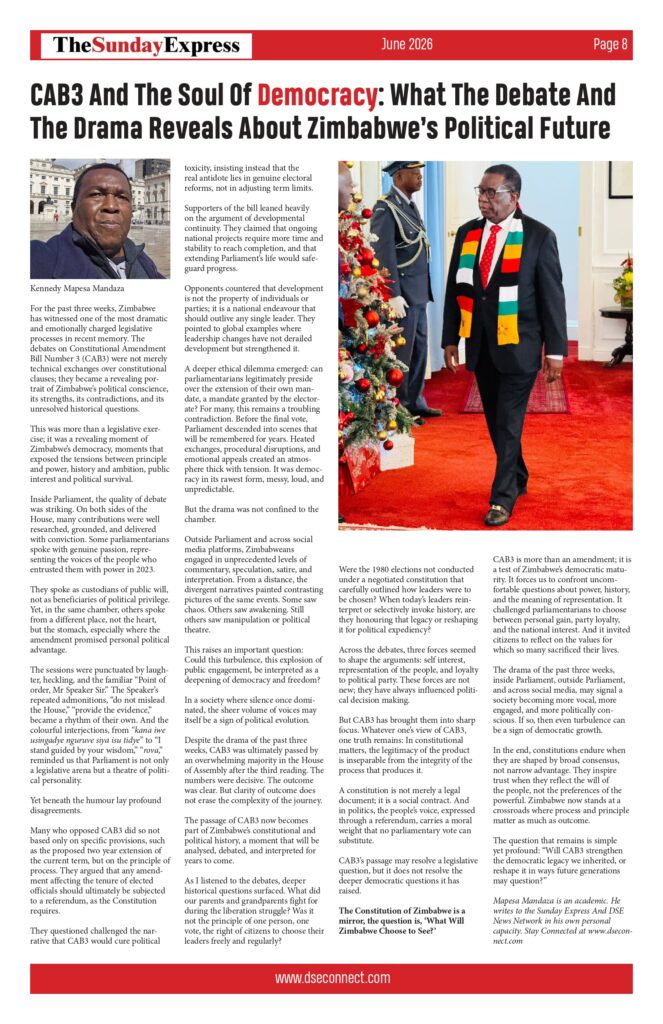
Kennedy Mapesa Mandaza
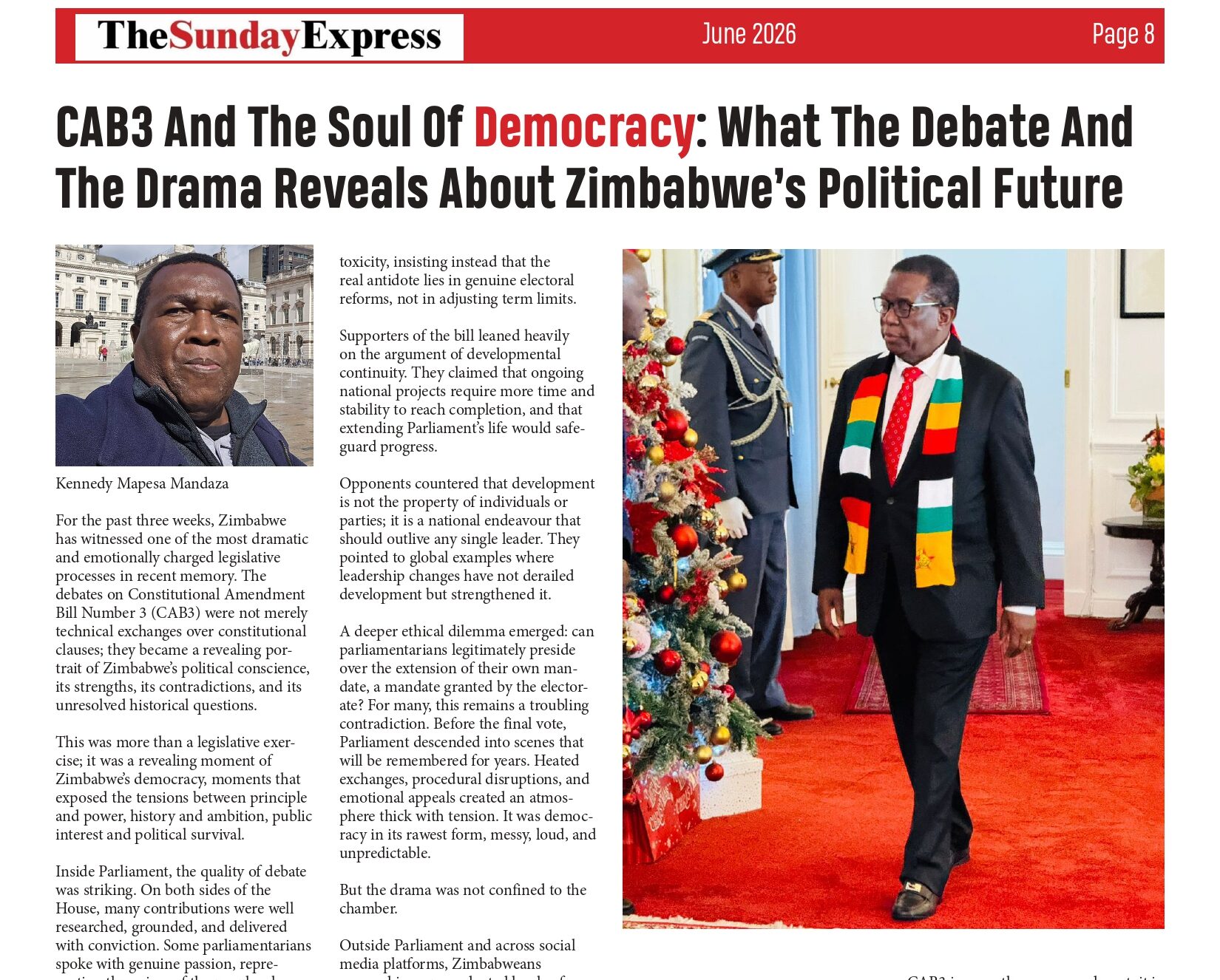
For the past three weeks, Zimbabwe has witnessed one of the most dramatic and emotionally charged legislative processes in recent memory.
The debates on Constitutional Amendment Bill Number 3 (CAB3) were not merely technical exchanges over constitutional clauses; they became a revealing portrait of Zimbabwe’s political conscience, its strengths, its contradictions, and its unresolved historical questions.
This was more than a legislative exercise; it was a revealing moment of Zimbabwe’s democracy, moments that exposed the tensions between principle and power, history and ambition, public interest and political survival.
Inside Parliament, the quality of debate was striking. On both sides of the House, many contributions were well researched, grounded, and delivered with conviction. Some parliamentarians spoke with genuine passion, representing the voices of the people who entrusted them with power in 2023.
They spoke as custodians of public will, not as beneficiaries of political privilege. Yet, in the same chamber, others spoke from a different place, not the heart, but the stomach, especially where the amendment promised personal political advantage.
The sessions were punctuated by laughter, heckling, and the familiar “Point of order, Mr Speaker Sir.” The Speaker’s repeated admonitions, “do not mislead the House,” “provide the evidence,” became a rhythm of their own. And the colourful interjections, from “kana iwe usingadye nguruve siya isu tidye” to “I stand guided by your wisdom,” “rova,” reminded us that Parliament is not only a legislative arena but a theatre of political personality.
Yet beneath the humour lay profound disagreements.
Many who opposed CAB3 did so not based only on specific provisions, such as the proposed two year extension of the current term, but on the principle of process. They argued that any amendment affecting the tenure of elected officials should ultimately be subjected to a referendum, as the Constitution requires.
They questioned challenged the narrative that CAB3 would cure political toxicity, insisting instead that the real antidote lies in genuine electoral reforms, not in adjusting term limits.
Supporters of the bill leaned heavily on the argument of developmental continuity. They claimed that ongoing national projects require more time and stability to reach completion, and that extending Parliament’s life would safeguard progress.
Opponents countered that development is not the property of individuals or parties; it is a national endeavour that should outlive any single leader. They pointed to global examples where leadership changes have not derailed development but strengthened it.
A deeper ethical dilemma emerged: can parliamentarians legitimately preside over the extension of their own mandate, a mandate granted by the electorate? For many, this remains a troubling contradiction.
Before the final vote, Parliament descended into scenes that will be remembered for years. Heated exchanges, procedural disruptions, and emotional appeals created an atmosphere thick with tension. It was democracy in its rawest form, messy, loud, and unpredictable.
Drama Not Confined To The Chamber
But the drama was not confined to the chamber.
Outside Parliament and across social media platforms, Zimbabweans engaged in unprecedented levels of commentary, speculation, satire, and interpretation. From a distance, the divergent narratives painted contrasting pictures of the same events. Some saw chaos. Others saw awakening. Still others saw manipulation or political theatre.
This raises an important question: Could this turbulence, this explosion of public engagement, be interpreted as a deepening of democracy and freedom?
In a society where silence once dominated, the sheer volume of voices may itself be a sign of political evolution.
Despite the drama of the past three weeks, CAB3 was ultimately passed by an overwhelming majority in the House of Assembly after the third reading. The numbers were decisive. The outcome was clear. But clarity of outcome does not erase the complexity of the journey.
The passage of CAB3 now becomes part of Zimbabwe’s constitutional and political history, a moment that will be analysed, debated, and interpreted for years to come.
As I listened to the debates, deeper historical questions surfaced. What did our parents and grandparents fight for during the liberation struggle? Was it not the principle of one person, one vote, the right of citizens to choose their leaders freely and regularly?
Were the 1980 elections not conducted under a negotiated constitution that carefully outlined how leaders were to be chosen? When today’s leaders reinterpret or selectively invoke history, are they honouring that legacy or reshaping it for political expediency?
Across the debates, three forces seemed to shape the arguments: self interest, representation of the people, and loyalty to political party. These forces are not new; they have always influenced political decision making. But CAB3 has brought them into sharp focus. Whatever one’s view of CAB3, one truth remains: In constitutional matters, the legitimacy of the product is inseparable from the integrity of the process that produces it.
A constitution is not merely a legal document; it is a social contract. And in politics, the people’s voice, expressed through a referendum, carries a moral weight that no parliamentary vote can substitute.
CAB3’s passage may resolve a legislative question, but it does not resolve the deeper democratic questions it has raised.
The Constitution of Zimbabwe is a mirror, the question is, ‘What Will Zimbabwe Choose to See?’
CAB3 is more than an amendment; it is a test of Zimbabwe’s democratic maturity. It forces us to confront uncomfortable questions about power, history, and the meaning of representation. It challenged parliamentarians to choose between personal gain, party loyalty, and the national interest. And it invited citizens to reflect on the values for which so many sacrificed their lives.
The drama of the past three weeks, inside Parliament, outside Parliament, and across social media, may signal a society becoming more vocal, more engaged, and more politically conscious. If so, then even turbulence can be a sign of democratic growth.
In the end, constitutions endure when they are shaped by broad consensus, not narrow advantage. They inspire trust when they reflect the will of the people, not the preferences of the powerful. Zimbabwe now stands at a crossroads where process and principle matter as much as outcome.
The question that remains is simple yet profound: “Will CAB3 strengthen the democratic legacy we inherited, or reshape it in ways future generations may question?”
Mapesa Mandaza Is An Academic. He Writes To The Sunday Express And DSE News Network In His Personal Capacity