By Wellington Muzengeza
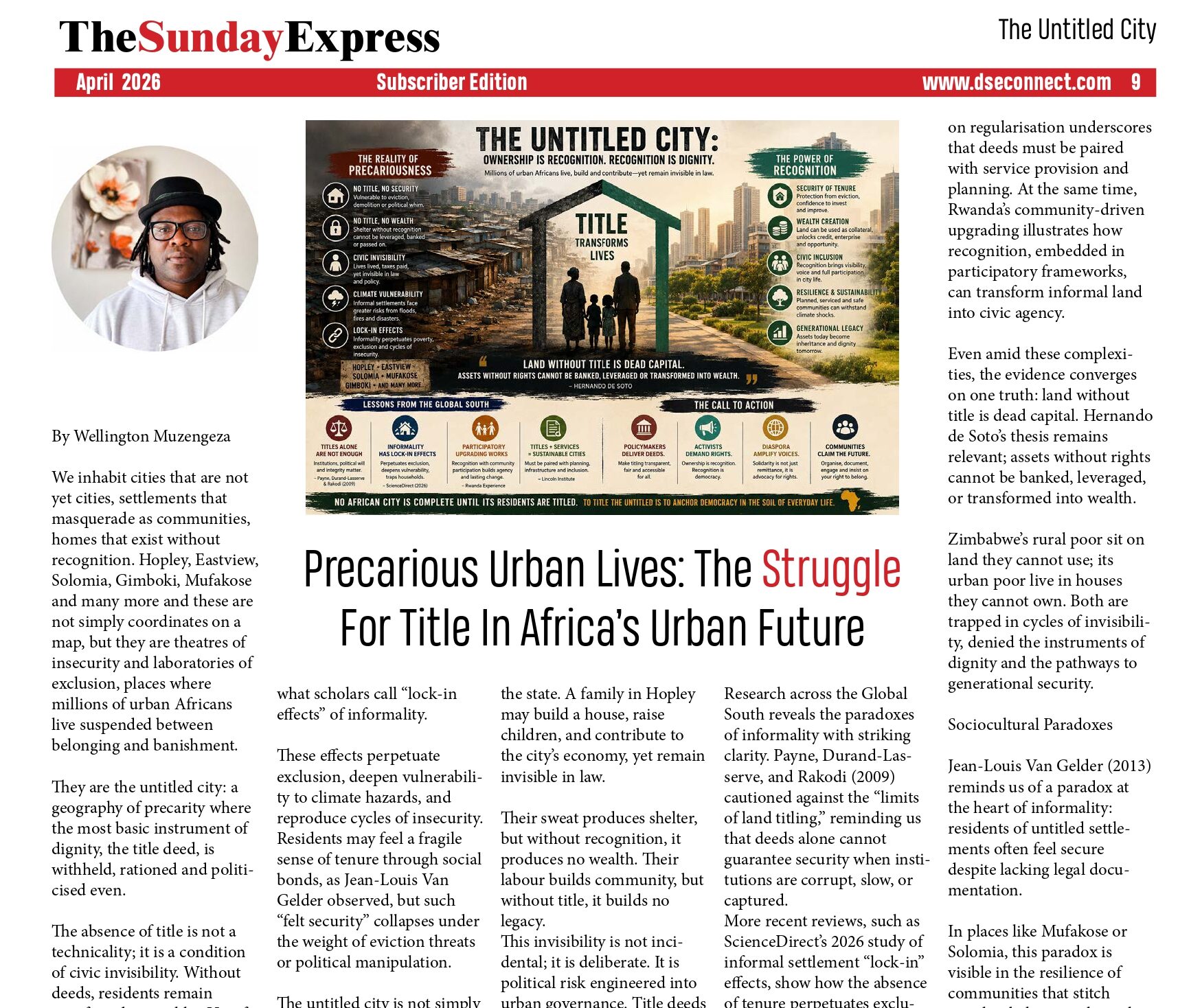
We inhabit cities that are not yet cities, settlements that masquerade as communities, homes that exist without recognition. Hopley, Eastview, Solomia, Gimboki, Mufakose and many more and these are not simply coordinates on a map, but they are theatres of insecurity and laboratories of exclusion, places where millions of urban Africans live suspended between belonging and banishment.
They are the untitled city: a geography of precarity where the most basic instrument of dignity, the title deed, is withheld, rationed and politicised even.
The absence of title is not a technicality; it is a condition of civic invisibility. Without deeds, residents remain unsafe and unwealthy. Unsafe, because tenure is perpetually precarious, vulnerable to eviction, demolition, or political whim.
Unwealthy, because shelter without recognition cannot be leveraged into collateral, cannot be converted into confidence, cannot be transformed into generational security. Poverty here is not merely about income; it is also about the denial of recognition, the foreclosure of ownership and the refusal of the right to belong.
This is the paradox of African urbanisation: our skylines rise, our populations swell, our informal settlements proliferate, yet millions remain untitled, trapped in what scholars call “lock‑in effects” of informality.
These effects perpetuate exclusion, deepen vulnerability to climate hazards, and reproduce cycles of insecurity. Residents may feel a fragile sense of tenure through social bonds, as Jean‑Louis Van Gelder observed, but such “felt security” collapses under the weight of eviction threats or political manipulation.
The untitled city is not simply a humanitarian crisis; it is a democratic crisis. It is the unfinished business of independence, the silent betrayal of urban modernity. To speak of poverty without speaking of title is to miss the essence of urban insecurity.
To speak of development without deeds is to celebrate growth without grounding, and to speak of democracy without ownership is to mistake procedure for substance.
The Politics of Precariousness
Urban poverty in Africa is too often narrated in narrow economic terms, wages, unemployment, or the informal hustle, yet the deeper wound is statelessness within the state. A family in Hopley may build a house, raise children, and contribute to the city’s economy, yet remain invisible in law.
Their sweat produces shelter, but without recognition, it produces no wealth. Their labour builds community, but without title, it builds no legacy.
This invisibility is not incidental; it is deliberate. It is political risk engineered into urban governance. Title deeds are withheld not because the bureaucracy is slow, but because power is strategic.
They are rationed as instruments of control, distributed selectively to reward loyalty or punish dissent. In this calculus, insecurity is not a failure of administration; it is the very architecture of authority.
The untitled city is therefore not simply a symptom of poverty; it is a strategy of power, a system designed to keep citizens perpetually precarious, perpetually dependent, perpetually denied the dignity of ownership.
Comparative Lessons
Research across the Global South reveals the paradoxes of informality with striking clarity. Payne, Durand‑Lasserve, and Rakodi (2009) cautioned against the “limits of land titling,” reminding us that deeds alone cannot guarantee security when institutions are corrupt, slow, or captured.
More recent reviews, such as ScienceDirect’s 2026 study of informal settlement “lock‑in” effects, show how the absence of tenure perpetuates exclusion, deepens vulnerability to climate hazards, and traps households in cycles of marginality.
In Ethiopia, settlers often resort to “bogus contracts”, fragile documents that mimic legality but collapse under scrutiny, exposing the precarious improvisations through which the poor attempt to claim space in the city.
Latin America offers further lessons. Studies from Mexico City and Guadalajara demonstrate that titling can improve recognition, but does not automatically prevent displacement; location, political will, and institutional integrity matter.
The Lincoln Institute’s work on regularisation underscores that deeds must be paired with service provision and planning. At the same time, Rwanda’s community‑driven upgrading illustrates how recognition, embedded in participatory frameworks, can transform informal land into civic agency.
Even amid these complexities, the evidence converges on one truth: land without title is dead capital. Hernando de Soto’s thesis remains relevant; assets without rights cannot be banked, leveraged, or transformed into wealth.
Zimbabwe’s rural poor sit on land they cannot use; its urban poor live in houses they cannot own. Both are trapped in cycles of invisibility, denied the instruments of dignity and the pathways to generational security.
Sociocultural Paradoxes
Jean‑Louis Van Gelder (2013) reminds us of a paradox at the heart of informality: residents of untitled settlements often feel secure despite lacking legal documentation.
In places like Mufakose or Solomia, this paradox is visible in the resilience of communities that stitch together belonging through social bonds, mutual trust, and everyday practices of solidarity, yet such “felt security” is fragile.
It collapses under the weight of eviction threats, climate shocks, or the manipulations of political power. Informality may generate identity and belonging, but it denies bankability, the ability to translate shelter into collateral, to convert presence into permanence, to transform survival into security.
The International Growth Centre warns that by 2030, unplanned settlements will house a vast share of the global population. Without recognition, these spaces will remain excluded from the circuits of infrastructure, services, and credit.
Zimbabwe’s untitled city is therefore not an aberration but part of a continental trajectory: a future where millions are urban in fact but stateless in law, citizens in practice but invisible in policy.
Towards Reform
We must reject the architecture of invisibility, cities without names, homes without recognition, and lives stripped of dignity. We must reject the permanence of untitled existence: unsafe, unwealthy, unanchored.
We must reject the illusion that democracy can flourish where ownership is denied, where citizens are reduced to tenants of the state rather than stakeholders in its future.
We must proclaim, with clarity and conviction, that no African city is complete until its residents are titled. We must insist that urban strategy begins not with charity or temporary relief, but with ownership and recognition.
We must affirm that the right to belong, to be seen, to be secure, to be bankable, is the very foundation upon which democracy rests, the cornerstone of dignity, and the pathway to generational futures.
Organisations devoted to civic renewal and urban justice must not approach this struggle as a mere technical adjustment; they must stand as vanguards of generational agency. Urban strategy cannot be reduced to spreadsheets and zoning maps; it is the unfinished business of liberation, the mandate to transform precarious lives into dignified futures.
The insecurity of Hopley is not a local misfortune; it is a mirror of Africa’s deferred promise. The untitled city is the residue of independence left incomplete, a reminder that sovereignty without ownership is hollow.
Policymakers must confront the hard truth: without deeds, there is no dignity. Activists must rally around the uncompromising demand: ownership is recognition. Diaspora networks must amplify the call: solidarity is not remittance alone, but advocacy for rights.
To title the untitled is to anchor democracy in the soil of everyday life, to convert dead capital into living futures, and to reclaim the right to belong as the cornerstone of Africa’s urban destiny.
A Blemish on the Urban Landscape
The untitled city is not merely a blemish on the urban landscape; it is a wound that bleeds across generations, eroding dignity and foreclosing futures. To heal it, we must insist, unequivocally, that every African family has the right to a title, the right to recognition, the right to transform shelter into security and presence into permanence.
The struggle for title is inseparable from the struggle for democracy itself. Ownership is not paperwork; it is the architecture of belonging, the anchor of citizenship, the foundation of generational wealth.
I will continue to name this injustice until the untitled city becomes the recognised city, until precarious lives are transfigured into dignified lives, and until Africa’s urban future is built not on exclusion but on the solid ground of rights, recognition, and reform.
Wellington Muzengeza is a Political Risk Analyst and Urban Strategist offering incisive insight on urban planning, infrastructure, leadership succession, and governance reform across Africa’s evolving post‑liberation urban landscapes. He Writes To The DSE News Network And The Sunday Express In His Personal Capacity.