DSE News Network
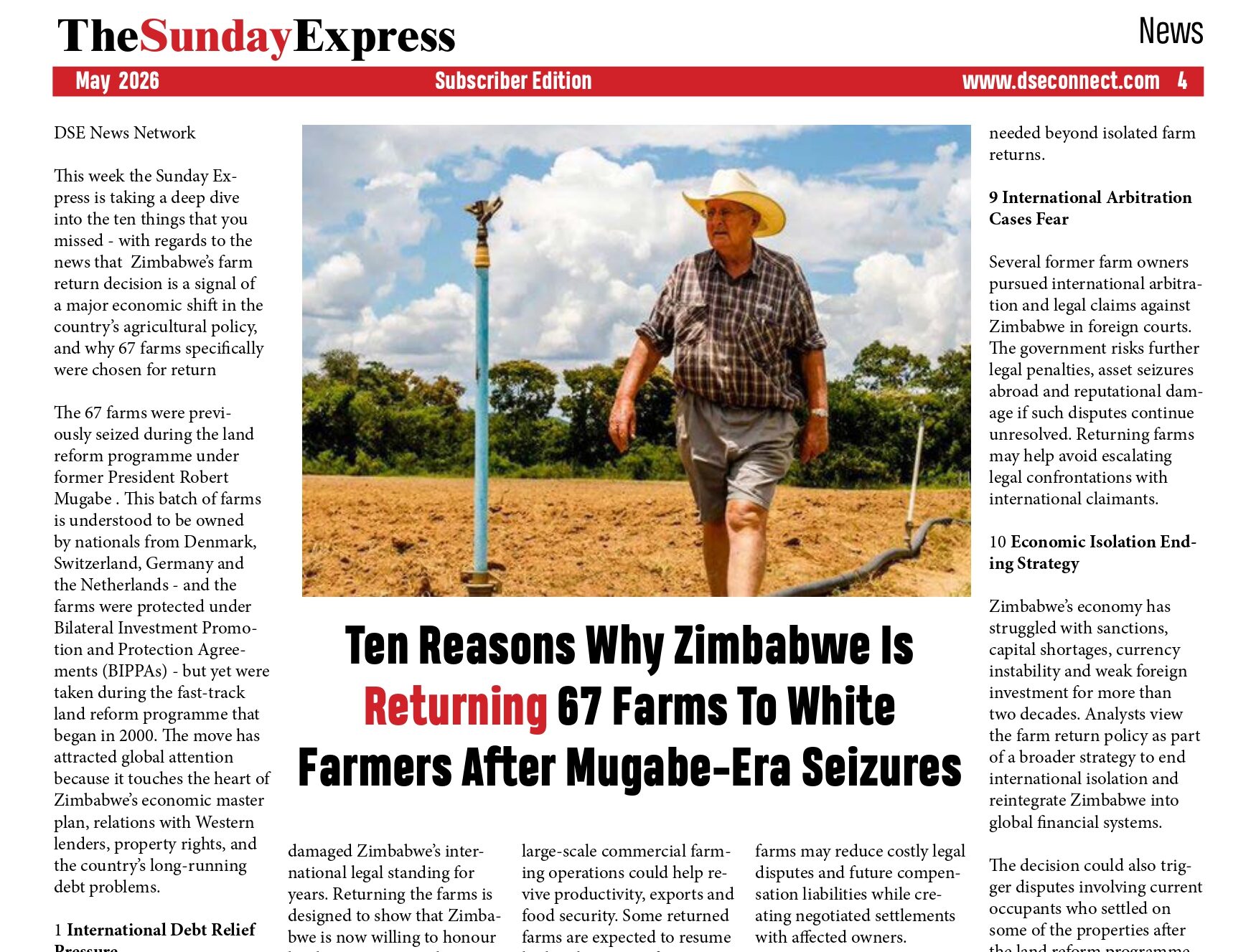
This week the Sunday Express is taking a deep dive into the ten things that you missed – with regards to the news that Zimbabwe’s farm return decision is a signal of a major economic shift in the country’s agricultural policy, and why 67 farms specifically were chosen for return.
The 67 farms were previously seized during the land reform programme under former President Robert Mugabe.
This batch of farms is understood to be owned by nationals from Denmark, Switzerland, Germany and the Netherlands – and the farms were protected under Bilateral Investment Promotion and Protection Agreements (BIPPAs) – but yet were taken during the fast-track land reform programme that began in 2000.
The move has attracted global attention because it touches the heart of Zimbabwe’s economic master plan, relations with Western lenders, property rights, and the country’s long-running debt problems.
1 International Debt Relief Pressure
The biggest reason behind the decision is Zimbabwe’s push to secure international debt relief. Global lenders including the World Bank and African Development Bank have consistently argued that unresolved land disputes remain a major obstacle to financial re-engagement.
Zimbabwe owes more than US$13 billion to international creditors. By returning protected farms, the government hopes to demonstrate respect for international agreements and improve its credibility with lenders and investors.
2 Bilateral Investment Agreements Enforcement
The 67 farms fall under international investment treaties signed between Zimbabwe and European countries. Those agreements guaranteed protection against expropriation without compensation.
Ignoring those treaties damaged Zimbabwe’s international legal standing for years. Returning the farms is designed to show that Zimbabwe is now willing to honour binding international commitments.
3 Foreign Investor Confidence Restoration
Zimbabwe’s leadership understands that investor confidence collapsed after the seizure of more than 4,000 white-owned commercial farms beginning in 2000.
Many foreign investors feared their assets could be taken without protection. Returning some farms sends a symbolic message that the government wants to rebuild trust with international business and financial markets.
4 Agricultural Production Recovery Goals
Before land reform, Zimbabwe was regarded as one of Africa’s strongest agricultural economies, exporting tobacco, maize and horticultural products across the world.
Supporters of the latest move argue that restoring some large-scale commercial farming operations could help revive productivity, exports and food security. Some returned farms are expected to resume high-value export farming operations.
5 Diplomatic Relations Improvement Efforts
Zimbabwe has spent years attempting to repair strained relations with European countries and Western governments.
The farm return decision is likely aimed at improving diplomatic engagement with countries whose citizens lost properties during the Mugabe era. The issue remained a major source of tension in Zimbabwe’s foreign relations for over two decades.
6 Compensation Costs Becoming Unsustainable
The government previously committed itself to compensating former white commercial farmers for improvements made on seized land. However, compensation obligations have become financially overwhelming.
Returning some farms may reduce costly legal disputes and future compensation liabilities while creating negotiated settlements with affected owners.
7 Political Transition Image Management
President Emmerson Mnangagwa has repeatedly presented his administration as different from the Mugabe era, particularly on economic management and international engagement.
The return of the farms helps reinforce the image of a government pursuing pragmatism rather than ideological confrontation.
8 Food Security Crisis Concerns
Zimbabwe continues to face recurring food insecurity linked to droughts, low agricultural productivity and climate shocks.
Some policymakers believe restoring experienced commercial farmers could strengthen agricultural output, improve irrigation systems and stabilise food supply chains. Critics, however, argue that broader structural reforms are still needed beyond isolated farm returns.
9 International Arbitration Cases Fear
Several former farm owners pursued international arbitration and legal claims against Zimbabwe in foreign courts.
The government risks further legal penalties, asset seizures abroad and reputational damage if such disputes continue unresolved. Returning farms may help avoid escalating legal confrontations with international claimants.
10 Economic Isolation Ending Strategy
Zimbabwe’s economy has struggled with sanctions, capital shortages, currency instability and weak foreign investment for more than two decades.
Analysts view the farm return policy as part of a broader strategy to end international isolation and reintegrate Zimbabwe into global financial systems.
The decision could also trigger disputes involving current occupants who settled on some of the properties after the land reform programme. Managing those competing claims peacefully will become one of the government’s biggest challenges.
Why Global Media Is Watching
The story is making international headlines because Zimbabwe’s land reform programme became one of the most controversial redistributions of land in post-colonial Africa. Critics blamed the seizures for destroying commercial agriculture, causing capital flight and accelerating economic collapse, while supporters viewed the reforms as correcting colonial land imbalances.
The return of even a small number of farms therefore represents more than a property issue. It signals a possible turning point in Zimbabwe’s relationship with global finance, international law and economic
Stay Connected On The DSE News Network