By Jabulani Chibaya
FY2025 marks a decisive break from Padenga Holdings’ past. What was once a niche, export-oriented agribusiness built on premium crocodile skins has now transitioned into a capital-intensive, gold-driven industrial operation.
This is not a diversification story—it is a structural reconfiguration of the group’s economic identity, with earnings increasingly shaped by geology, processing efficiency, and global commodity cycles rather than luxury demand.
The headline numbers tell a story of strong, mining-led acceleration. Revenue rose to US$265.8 million, up 26% from the prior year, while EBITDA surged to US$113.0 million, reflecting a 72% increase. Profit before tax reached US$93.9 million (up 114%), with profit after tax at US$70.7 million.
The balance sheet expanded alongside this growth, as the group deepened its investment in mining assets. Yet beneath this performance lies a more nuanced reality: 94% of revenue is now attributable to mining, EBITDA is scaling rapidly with operational momentum, and profitability—while significantly improved—still carries the weight of cost pressures and capital structure dynamics.
The centre of gravity has firmly shifted. Mining has overtaken agribusiness as the dominant contributor to both revenue and earnings, positioning gold as the group’s primary value driver. This transition fundamentally alters Padenga’s risk-return profile.
Where the business once operated within relatively stable, demand-driven export markets, it now operates within a volatile commodity system where performance is dictated by ore grade, cost discipline, and gold price movements.
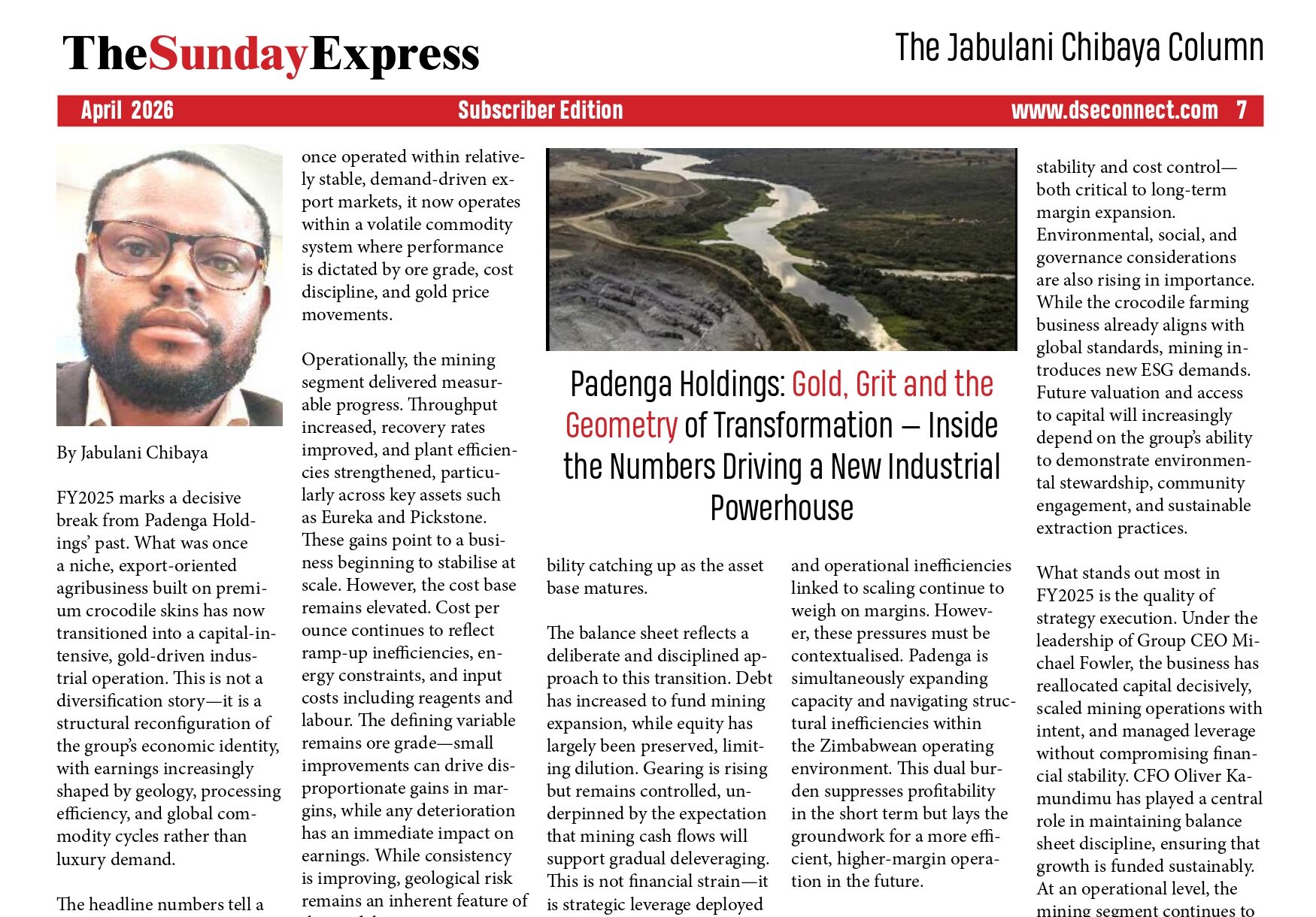
Operationally, the mining segment delivered measurable progress. Throughput increased, recovery rates improved, and plant efficiencies strengthened, particularly across key assets such as Eureka and Pickstone. These gains point to a business beginning to stabilise at scale.
However, the cost base remains elevated. Cost per ounce continues to reflect ramp-up inefficiencies, energy constraints, and input costs including reagents and labour.
The defining variable remains ore grade—small improvements can drive disproportionate gains in margins, while any deterioration has an immediate impact on earnings. While consistency is improving, geological risk remains an inherent feature of the model.
EBITDA expansion signals that operating leverage is beginning to take hold, but margins remain partially compressed by structural and transitional factors. The Intermediated Money Transfer Tax (IMTT) continues to erode value, while power costs, processing inefficiencies, and the friction of scaling a mining operation weigh on margins.
These are characteristic pressures of a business still in its build phase—absorbing inefficiencies today in order to unlock efficiency and scale tomorrow.
Profitability has improved significantly, but still lags the full earnings potential of the asset base. Financing costs associated with debt-funded capital expenditure, alongside tax inefficiencies and inflationary pressures, continue to temper bottom-line performance.
This reflects a familiar pattern in capital-intensive sectors: operational capacity expands ahead of fully realised earnings, with profitability catching up as the asset base matures.
The balance sheet reflects a deliberate and disciplined approach to this transition. Debt has increased to fund mining expansion, while equity has largely been preserved, limiting dilution. Gearing is rising but remains controlled, underpinned by the expectation that mining cash flows will support gradual deleveraging. This is not financial strain—it is strategic leverage deployed into productive assets.
Return metrics reinforce the investment-phase nature of the business. Return on equity is improving as profitability scales, but return on assets remains subdued due to the rapid expansion of the asset base. As operations mature and utilisation improves, returns are expected to inflect more meaningfully.
Amid this transformation, the agribusiness segment continues to play a stabilising role. Following a deliberate right-sizing into a leaner, one-farm model targeting approximately 25,000 skins annually, the unit remains cash generative despite softer global luxury demand. Its contribution may be diminishing in relative terms, but its strategic value remains intact—as a hedge against the inherent volatility of mining earnings.
Cost pressures remain a defining feature of the current phase. Beyond IMTT, energy reliability, input costs, and operational inefficiencies linked to scaling continue to weigh on margins. However, these pressures must be contextualised.
Padenga is simultaneously expanding capacity and navigating structural inefficiencies within the Zimbabwean operating environment. This dual burden suppresses profitability in the short term but lays the groundwork for a more efficient, higher-margin operation in the future.
The macroeconomic backdrop adds further complexity. Domestic challenges—currency volatility, policy distortions, and power constraints—intersect with a global environment where gold continues to benefit from inflation, geopolitical instability, and monetary uncertainty. In this context, Padenga has effectively repositioned itself as a leveraged proxy to global gold dynamics, with local execution determining the extent of value capture.
Technology is emerging as a critical enabler of this transition. Investments in geological modelling, ore body mapping, and recovery optimisation are beginning to translate into operational gains. Improvements in underground infrastructure, including hoisting systems and shaft efficiency, are reducing downtime and enhancing throughput.
In parallel, the rollout of 4.9MW and 5MW solar projects at Pickstone and Eureka, expected to come online in early 2026, signals a strategic move toward energy stability and cost control—both critical to long-term margin expansion.
Environmental, social, and governance considerations are also rising in importance. While the crocodile farming business already aligns with global standards, mining introduces new ESG demands. Future valuation and access to capital will increasingly depend on the group’s ability to demonstrate environmental stewardship, community engagement, and sustainable extraction practices.
What stands out most in FY2025 is the quality of strategy execution. Under the leadership of Group CEO Michael Fowler, the business has reallocated capital decisively, scaled mining operations with intent, and managed leverage without compromising financial stability.
CFO Oliver Kamundimu has played a central role in maintaining balance sheet discipline, ensuring that growth is funded sustainably. At an operational level, the mining segment continues to drive throughput, efficiency, and production gains, while agribusiness—now leaner—remains a stabilising force.
Looking ahead, the trajectory is clear. Mining will continue to dominate the earnings profile, with further expansion likely through underground development and asset optimisation. The group is approaching a critical inflection point where it transitions from being capital expenditure-heavy to increasingly cash flow generative. As this shift materialises, the full earnings power of the asset base is expected to become more visible.
This is not a finished company. It is an industrial system being built in real time—one ounce at a time.
For investors, Padenga now represents a fundamentally different proposition. It is no longer a defensive agribusiness play but a high-beta gold exposure, with returns increasingly tied to both commodity prices and execution quality. Equity investors will focus on gold price leverage, analysts will scrutinise cost per ounce and ore grade consistency, and debt investors will monitor cash flow coverage and balance sheet resilience.
Ultimately, Padenga’s FY2025 results reveal a company in motion—growing rapidly, but still absorbing the costs of transformation; profitable, but not yet fully optimised; expanding, but with discipline. Beneath the numbers lies a deeper shift: from biological assets to geological assets, from predictable demand cycles to commodity volatility, and from low capital intensity to industrial-scale investment.
The investment thesis is clear. Padenga is evolving into a high-beta gold industrial play, anchored by a cash-generative agribusiness hedge.
The defining question is whether it can maintain ore quality, control costs, and scale efficiently. If it succeeds, the current performance represents the early stages of a much larger earnings cycle. If it falters, volatility will remain embedded in the journey.
This is not a finished company. It is an industrial system being built in real time—one ounce at a time.
Jabulani Chibaya: MBA I GRC | FinTech | Data Governance | Open Source Software| TMT | Business Intelligence | Analytics, DataOps, PropTech | Distributed Systems. Read the full article on www.dseconnect.com