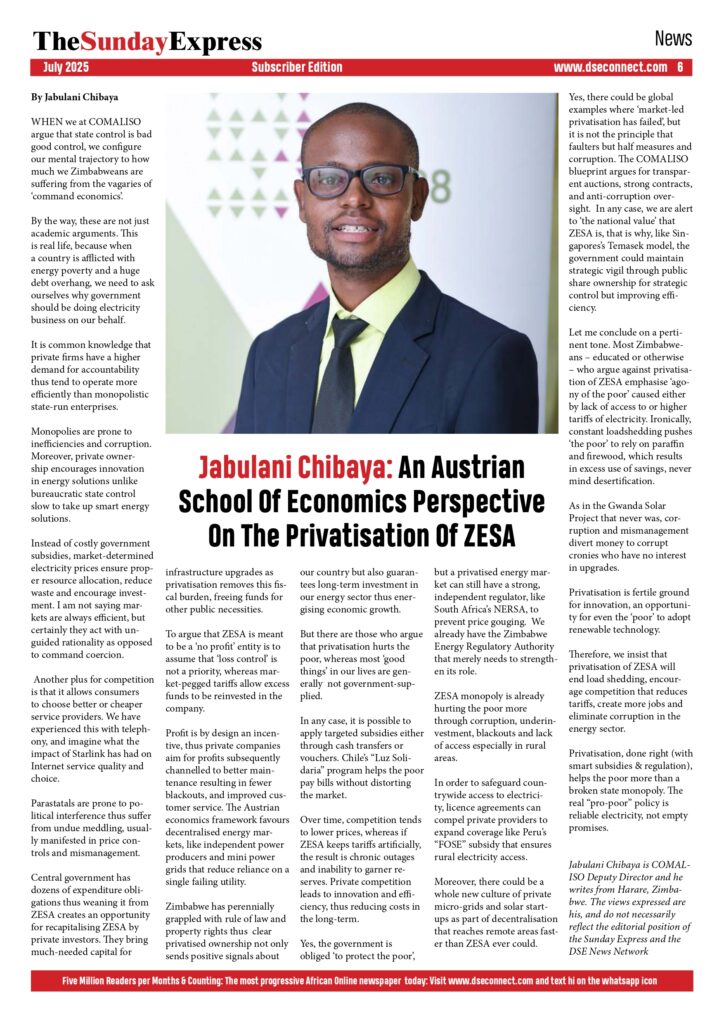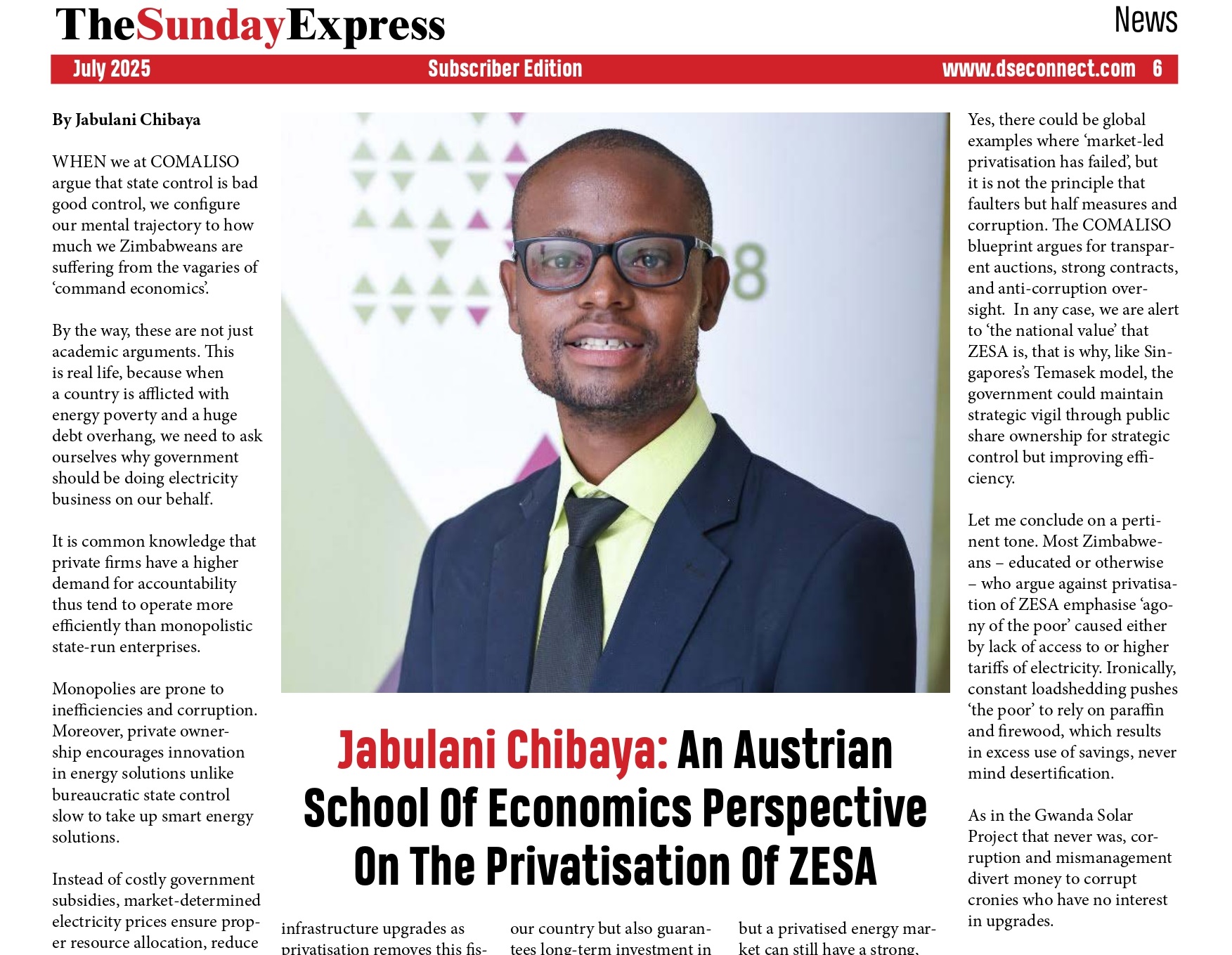
By Jabulani Chibaya
When we at COMALISO argue that state control is bad good control, we configure our mental trajectory to how much we Zimbabweans are suffering from the vagaries of ‘command economics’.
By the way, these are not just academic arguments. This is real life, because when a country is afflicted with energy poverty and a huge debt overhang, we need to ask ourselves why government should be doing electricity business on our behalf.
It is common knowledge that private firms have a higher demand for accountability thus tend to operate more efficiently than monopolistic state-run enterprises.
Monopolies are prone to inefficiencies and corruption. Moreover, private ownership encourages innovation in energy solutions unlike bureaucratic state control slow to take up smart energy solutions.
Instead of costly government subsidies, market-determined electricity prices ensure proper resource allocation, reduce waste and encourage investment. I am not saying markets are always efficient, but certainly they act with unguided rationality as opposed to command coercion.
Another plus for competition is that it allows consumers to choose better or cheaper service providers. We have experienced this with telephony, and imagine what the impact of Starlink has had on Internet service quality and choice.
Parastatals are prone to political interference thus suffer from undue meddling, usually manifested in price controls and mismanagement.
Central government has dozens of expenditure obligations thus weaning it from ZESA creates an opportunity for recapitalising ZESA by private investors. They bring much-needed capital for infrastructure upgrades as privatisation removes this fiscal burden, freeing funds for other public necessities.
To argue that ZESA is meant to be a ‘no profit’ entity is to assume that ‘loss control’ is not a priority, whereas market-pegged tariffs allow excess funds to be reinvested in the company.
Profit is by design an incentive, thus private companies aim for profits subsequently channelled to better maintenance resulting in fewer blackouts, and improved customer service. The Austrian economics framework favours decentralised energy markets, like independent power producers and mini power grids that reduce reliance on a single failing utility.
Zimbabwe has perennially grappled with rule of law and property rights thus clear privatised ownership not only sends positive signals about our country but also guarantees long-term investment in our energy sector thus energising economic growth.
But there are those who argue that privatisation hurts the poor, whereas most ‘good things’ in our lives are generally not government-supplied.
In any case, it is possible to apply targeted subsidies either through cash transfers or vouchers. Chile’s “Luz Solidaria” program helps the poor pay bills without distorting the market.
Over time, competition tends to lower prices, whereas if ZESA keeps tariffs artificially, the result is chronic outages and inability to garner reserves. Private competition leads to innovation and efficiency, thus reducing costs in the long-term.
Yes, the government is obliged ‘to protect the poor’, but a privatised energy market can still have a strong, independent regulator, like South Africa’s NERSA, to prevent price gouging. We already have the Zimbabwe Energy Regulatory Authority that merely needs to strengthen its role.
ZESA monopoly is already hurting the poor more through corruption, underinvestment, blackouts and lack of access especially in rural areas.
In order to safeguard countrywide access to electricity, licence agreements can compel private providers to expand coverage like Peru’s “FOSE” subsidy that ensures rural electricity access.
Moreover, there could be a whole new culture of private micro-grids and solar startups as part of decentralisation that reaches remote areas faster than ZESA ever could.
Yes, there could be global examples where ‘market-led privatisation has failed’, but it is not the principle that faulters but half measures and corruption. The COMALISO blueprint argues for transparent auctions, strong contracts, and anti-corruption oversight. In any case, we are alert to ‘the national value’ that ZESA is, that is why, like Singapores’s Temasek model, the government could maintain strategic vigil through public share ownership for strategic control but improving efficiency.
Let me conclude on a pertinent tone. Most Zimbabweans – educated or otherwise – who argue against privatisation of ZESA emphasise ‘agony of the poor’ caused either by lack of access to or higher tariffs of electricity. Ironically, constant loadshedding pushes ‘the poor’ to rely on paraffin and firewood, which results in excess use of savings, never mind desertification.
As in the Gwanda Solar Project that never was, corruption and mismanagement divert money to corrupt cronies who have no interest in upgrades.
Privatisation is fertile ground for innovation, an opportunity for even the ‘poor’ to adopt renewable technology.
Therefore, we insist that privatisation of ZESA will end load shedding, encourage competition that reduces tariffs, create more jobs and eliminate corruption in the energy sector.
Privatisation, done right (with smart subsidies & regulation), helps the poor more than a broken state monopoly. The real “pro-poor” policy is reliable electricity, not empty promises.
Jabulani Chibaya is COMALISO Deputy Director and he writes from Harare, Zimbabwe. The views expressed are his, and do not necessarily reflect the editorial position of the Sunday Express and the DSE News Network