By Paison Tazvivinga and Irene Bumi
A new class of Zimbabwean philanthropist-entrepreneurs is quietly filling the gaps the state cannot reach. As economists and social scientists, we argue this is not a curiosity — it is a national development asset that policy must learn to harness.
In a nation where public budgets are stretched thin, where psychiatric hospitals crumble and rural communities go without clean water, the emergence of private citizens who channel their wealth back into the social fabric of Zimbabwe deserves more than headlines — it deserves serious analytical attention.
Three names stand out in this emerging class of philanthropist-entrepreneurs: Sir Wicknell Chivhayo, Kudakwashe Tagwirei, and Paul Tungwarara. Together, they present a new and imperfect but genuinely significant force in Zimbabwe’s developmental story.
The economics of private giving
Development economists have long understood that in economies with constrained fiscal capacity, private philanthropic capital acts as a social stabiliser.
When the state cannot adequately fund arts, healthcare, sports, or grassroots welfare, wealthy individuals who step into that gap perform an economically vital function — one classical theory attributes exclusively to governments.
Zimbabwe’s case is instructive.
In December 2025, Chivhayo donated US$5.6 million to the Cheer Funds of the Zimbabwe Defence Forces, the Zimbabwe Republic Police, and the Prison Services — institutions that support serving and retired members, widows, orphans, and injured veterans. This is not a mere spectacle. It is the private financing of social safety nets that the public fiscus cannot adequately sustain.
The multiplier in action
His documented disbursements of over US$70 million in personal giveaways over 24 months represent what development economists call extra-governmental social expenditure.
In a country where GDP per capita sits around $1,700, the multiplier effect of these injections is outsized: cash gifts to musicians sustain the cultural economy; vehicle donations to churches enable community outreach logistics; sports sponsorships seed the pipeline of elite athletes.
Most recently, in 2026, Chivhayo pledged a further US$5 million to the Zion Christian Church, donated 82 vehicles to church leaders, and committed to a US$5 million community fund after withdrawing a controversial US$3.6 million parliamentary pledge — demonstrating both the scale of his philanthropic ambition and his capacity to recalibrate when public sentiment demands it.
“As young patriotic businesspeople, we must fully embrace our responsibility to complement government’s efforts through corporate social responsibility.” — Wicknell Chivhayo, December 2025.
Zimbabwe’s philanthropic triumvirate
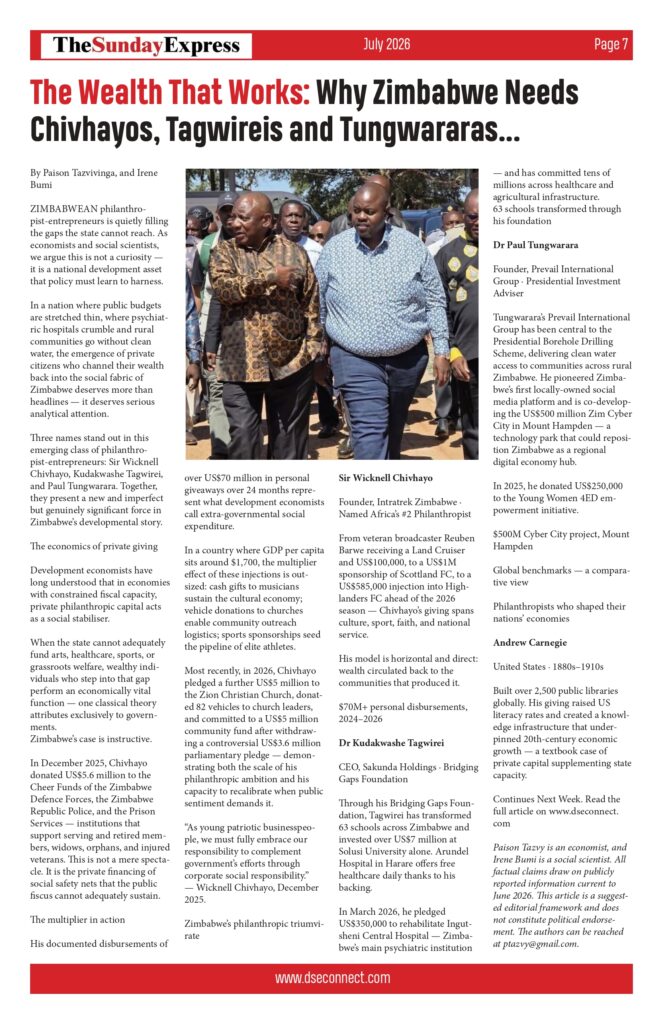
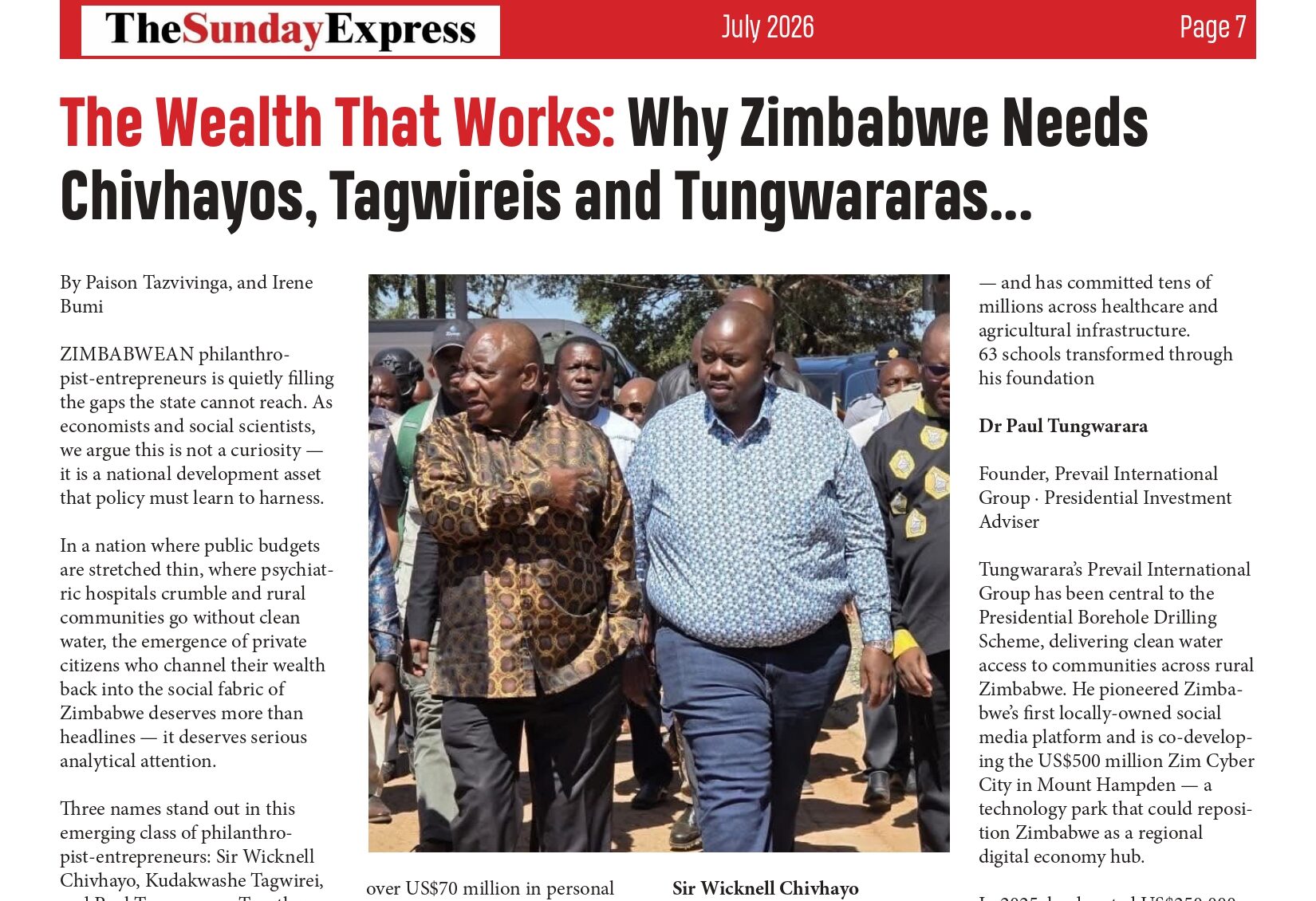
Sir Wicknell Chivhayo
Founder, Intratrek Zimbabwe · Named Africa’s #2 Philanthropist
From veteran broadcaster Reuben Barwe receiving a Land Cruiser and US$100,000, to a US$1M sponsorship of Scottland FC, to a US$585,000 injection into Highlanders FC ahead of the 2026 season — Chivhayo’s giving spans culture, sport, faith, and national service.
His model is horizontal and direct: wealth circulated back to the communities that produced it.
$70M+ personal disbursements, 2024–2026
Dr Kudakwashe Tagwirei
CEO, Sakunda Holdings · Bridging Gaps Foundation
Through his Bridging Gaps Foundation, Tagwirei has transformed 63 schools across Zimbabwe and invested over US$7 million at Solusi University alone. Arundel Hospital in Harare offers free healthcare daily thanks to his backing.
In March 2026, he pledged US$350,000 to rehabilitate Ingutsheni Central Hospital — Zimbabwe’s main psychiatric institution — and has committed tens of millions across healthcare and agricultural infrastructure.
63 schools transformed through his foundation
Dr Paul Tungwarara
Founder, Prevail International Group · Presidential Investment Adviser
Tungwarara’s Prevail International Group has been central to the Presidential Borehole Drilling Scheme, delivering clean water access to communities across rural Zimbabwe. He pioneered Zimbabwe’s first locally-owned social media platform and is co-developing the US$500 million Zim Cyber City in Mount Hampden — a technology park that could reposition Zimbabwe as a regional digital economy hub.
In 2025, he donated US$250,000 to the Young Women 4ED empowerment initiative.
$500M Cyber City project, Mount Hampden
Global benchmarks — a comparative view
Philanthropists who shaped their nations’ economies
Andrew Carnegie
United States · 1880s–1910s
Built over 2,500 public libraries globally. His giving raised US literacy rates and created a knowledge infrastructure that underpinned 20th-century economic growth — a textbook case of private capital supplementing state capacity.
Aliko Dangote
Nigeria · 2000s–present
Africa’s richest man channelled private wealth into cement, fertiliser and refining, creating hundreds of thousands of jobs while his foundation funds nutrition and health.
In 2025, he signed a $1 billion deal with Zimbabwe on cement and fertiliser — directly facilitated by Tungwarara’s network.
Strive Masiyiwa
Zimbabwe/Global · 1990s–present
Founded Econet Wireless, then committed to educating over 250,000 Zimbabwean orphans annually through the Higherlife Foundation — proving local capital, when structured and long-term, can be transformative at generational scale.
Tony Elumelu
Nigeria · 2010s–present
Committed $100M to seed 10,000 African entrepreneurs. His “Africapitalism” doctrine holds that wealth creation by the private sector, when reinvested locally, is the surest path to continental development — precisely what Zimbabwe’s triumvirate embodies in practice.
Social science lens
Visibility, aspiration and the demonstration effect
Social scientists often underestimate the power of the demonstration effect — the capacity of highly visible success stories to reshape cultural norms around ambition.
In a country where decades of economic contraction eroded confidence in local wealth creation, figures like Chivhayo, Tagwirei, and Tungwarara serve a symbolic function no government campaign can replicate.
Harvard sociologist Orlando Patterson’s work on cultural capital suggests that such figures generate what he calls “aspirational contagion” in deprived communities.
When young Zimbabweans watch a man who started as a wages clerk in 1997 now donating luxury vehicles by the dozen and funding the rehabilitation of hospitals, they receive a data point that challenges fatalism and inspires enterprise.
Healthcare & infrastructure
Filling the fiscal gap in public services
Perhaps nowhere is the development impact of private philanthropy more evident than in health and infrastructure. Tagwirei’s US$350,000 pledge to Ingutsheni Central Hospital in March 2026 — Zimbabwe’s main psychiatric facility — came at a fundraiser that raised over $2 million in total, with the state itself contributing.
This is co-financing at its most practical: private wealth unlocking public commitment.
Similarly, Tungwarara’s borehole programme has delivered potable water to rural communities that waited decades for government delivery. The Presidential Borehole Scheme, implemented through Prevail International under contract to ZINWA, is a case study in what economists call public-private development partnerships — a model Kenya and Rwanda have formalised into national policy.
“The most effective development intervention is sometimes a wealthy compatriot who refuses to leave — and channels his fortune toward the communities that shaped him.” – Paison Tazvy
Cultural economy
Sports, arts and the soft economy
Chivhayo’s investment in Zimbabwean football — a US$1 million sponsorship of Scottland FC in 2025 and a US$585,000 injection into Highlanders for the 2026 season — reflects an understanding of what economists call the sports and creative economy.
In the UK, the Premier League contributes over £7.6 billion annually to GDP. In Africa, chronically underfunded leagues destroy this potential before it can manifest.
His support for musicians and broadcasters — veteran journalist Reuben Barwe received a Land Cruiser and US$100,000 in May 2025 alone — mirrors what France does through its intermittents du spectacle system: ensuring cultural producers can sustain their craft. A functioning cultural economy generates tourism, national identity, and soft power, none of which appear on a government balance sheet but all of which compound into growth.
Digital economy
Tech, connectivity and Vision 2030
Tungwarara’s co-development of the US$500 million Zim Cyber City at Mount Hampden — partnered with Dubai’s Mulk International — represents a different but equally vital form of nation-building investment.
Technology parks are proven economic accelerators: India’s HITEC City in Hyderabad generated over $100 billion in software exports from a single public-private initiative. Zimbabwe’s version is embryonic, but the model is sound.
His appointments as Special Presidential Investment Adviser and the 2024 Africa Investment Leaders Forum Top Investor Award reflect an international confidence in Zimbabwe’s private sector capacity that diplomatic missions alone cannot secure. These are sovereign brand ambassadors, opening doors to foreign capital that public institutions struggle to reach.
Policy recommendation
From episodic generosity to systemic impact: a framework for structured philanthropy
The question is not whether Zimbabwe has philanthropic capital — the evidence is overwhelming that it does. The question is whether the policy environment is structured to amplify it. Governments in Ghana, Rwanda and Kenya have introduced philanthropic tax incentive frameworks that direct private giving toward health, education and infrastructure. Zimbabwe has no equivalent mechanism.
Policymakers should consider a National Philanthropic Partnership Framework: co-investment models where private donors match-fund government health, education, and infrastructure projects within transparent accountability structures. Chivhayo’s proposed US$5 million community fund — announced after he withdrew the contested parliamentary pledge — is exactly the kind of re-channelled giving such a framework would institutionalise and scale.
Tagwirei’s Bridging Gaps Foundation, with its documented impact across 63 schools and major health facilities, already functions at the scale of a medium-sized development NGO. Formalising its relationship with the Ministry of Education and the Ministry of Health — through co-financing protocols — would convert episodic philanthropy into a permanent development infrastructure asset.
Zimbabwe does not lack wealth or the will to use it generously. What it needs now is the institutional architecture — legal, fiscal, and cultural — to ensure that private capital circulates in ways that build the nation across generations. Chivhayo, Tagwirei, and Tungwarara are not a finished product. They are a proof of concept. The task for economists, policymakers, and civic leaders is to read that proof carefully — and build on it.
Paison Tazvy is an economist, and Irene Bumi is a social scientist. All factual claims draw on publicly reported information current to June 2026. This article is a suggested editorial framework and does not constitute political endorsement. The authors can be reached at ptazvy@gmail.com.