Aldrine Maromo
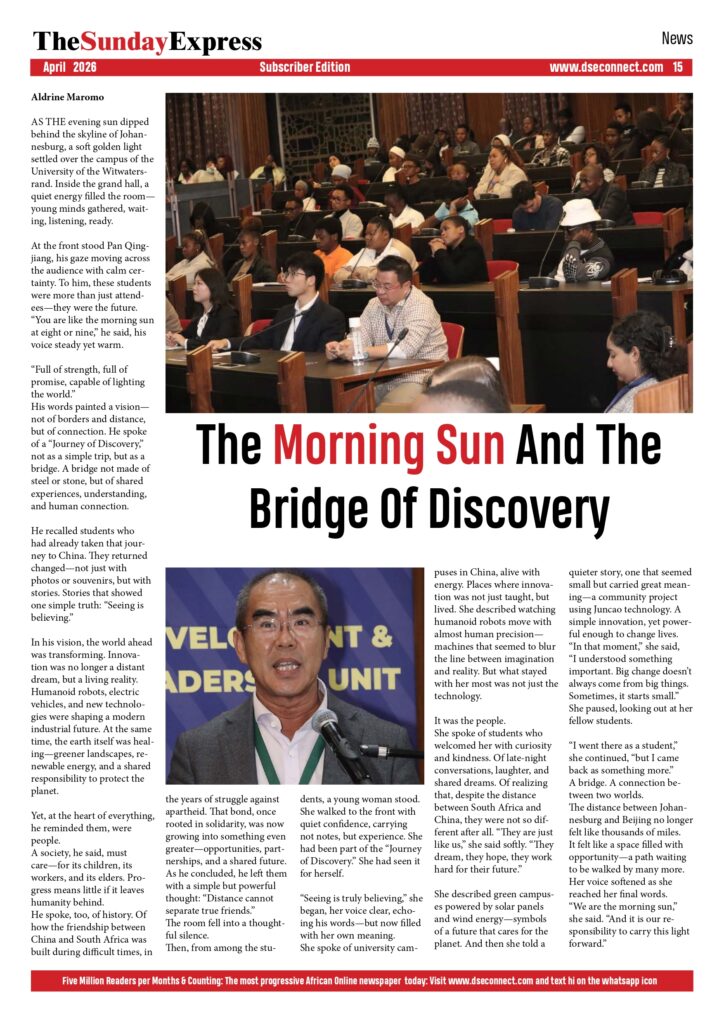
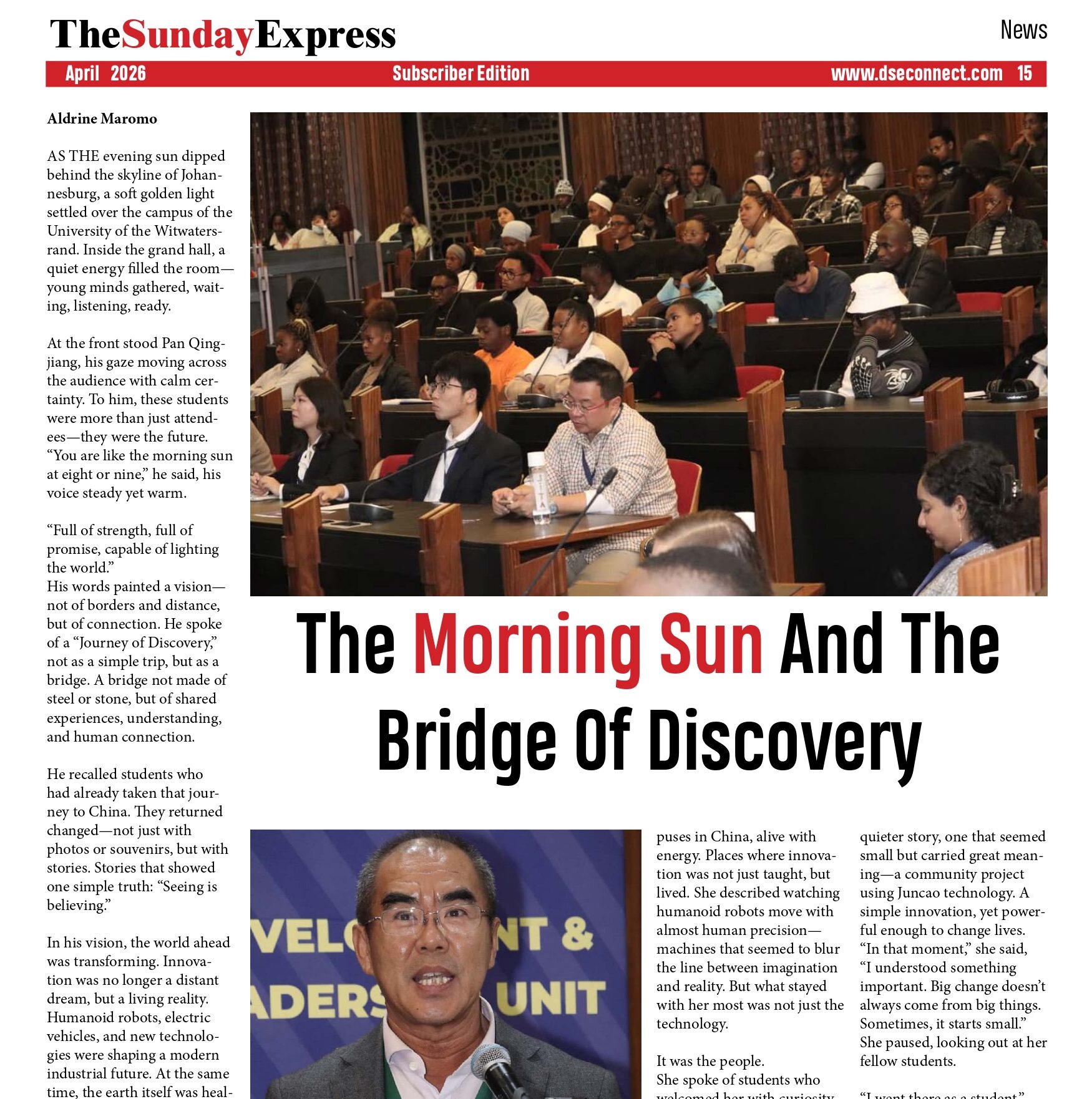
As the evening sun dipped behind the skyline of Johannesburg, a soft golden light settled over the campus of the University of the Witwatersrand. Inside the grand hall, a quiet energy filled the room—young minds gathered, waiting, listening, ready.
At the front stood Pan Qingjiang, his gaze moving across the audience with calm certainty. To him, these students were more than just attendees—they were the future. “You are like the morning sun at eight or nine,” he said, his voice steady yet warm.
“Full of strength, full of promise, capable of lighting the world.” His words painted a vision—not of borders and distance, but of connection. He spoke of a “Journey of Discovery,” not as a simple trip, but as a bridge. A bridge not made of steel or stone, but of shared experiences, understanding, and human connection.
He recalled students who had already taken that journey to China. They returned changed—not just with photos or souvenirs, but with stories. Stories that showed one simple truth: “Seeing is believing.”
In his vision, the world ahead was transforming. Innovation was no longer a distant dream, but a living reality. Humanoid robots, electric vehicles, and new technologies were shaping a modern industrial future.
At the same time, the earth itself was healing—greener landscapes, renewable energy, and a shared responsibility to protect the planet.
Yet, at the heart of everything, he reminded them, were people. A society, he said, must care—for its children, its workers, and its elders. Progress means little if it leaves humanity behind.
He spoke, too, of history. Of how the friendship between China and South Africa was built during difficult times, in the years of struggle against apartheid. That bond, once rooted in solidarity, was now growing into something even greater—opportunities, partnerships, and a shared future.
As he concluded, he left them with a simple but powerful thought: “Distance cannot separate true friends.” The room fell into a thoughtful silence. When, from among the students, a young woman stood.
She walked to the front with quiet confidence, carrying not notes, but experience.
She had been part of the “Journey of Discovery.” She had seen it for herself.
“Seeing is truly believing,” she began, her voice clear, echoing his words—but now filled with her own meaning.
She spoke of university campuses in China, alive with energy. Places where innovation was not just taught, but lived. She described watching humanoid robots move with almost human precision—machines that seemed to blur the line between imagination and reality. But what stayed with her most was not just the technology.
It was the people.
She spoke of students who welcomed her with curiosity and kindness. Of late-night conversations, laughter, and shared dreams. Of realising that, despite the distance between South Africa and China, they were not so different after all.
“They are just like us,” she said softly. “They dream, they hope, they work hard for their future.”
She described green campuses powered by solar panels and wind energy—symbols of a future that cares for the planet. And then she told a quieter story, one that seemed small but carried great meaning—a community project using Juncao technology.
A simple innovation, yet powerful enough to change lives.
“In that moment,” she said, “I understood something important. Big change doesn’t always come from big things. Sometimes, it starts small.” She paused, looking out at her fellow students.
“I went there as a student,” she continued, “but I came back as something more.” A bridge. A connection between two worlds.
The distance between Johannesburg and Beijing no longer felt like thousands of miles. It felt like a space filled with opportunity—a path waiting to be walked by many more. Her voice softened as she reached her final words.
“We are the morning sun,” she said. “And it is our responsibility to carry this light forward.”