By Kennedy Mapesa Mandaza
For decades, the teaching profession in Zimbabwe stood as a beacon of dignity, discipline, and intellectual authority. Before the year 2000, teachers were not merely employees of the state—they were custodians of knowledge, moral compasses, and symbols of aspirations and the heartbeat of their communities.
Their presence evoked respect, their conduct inspired emulation, and their influence shaped the aspirations of entire villages and townships.
Today, the profession tells a different story, one marked by economic hardship, mass migration, and a painful erosion of status and dignity. Yet, amid the decline, the call to restore the honour of teaching has never been more urgent.
In the years following independence, Zimbabwe built one of Africa’s most admired education systems. At the centre of this achievement stood the teacher—an unmistakable figure whose very appearance communicated purpose and pride, commanded respect and whose influence shaped generations. They were well-trained, well-regarded, and deeply embedded in the social fabric of their communities.
“The chalkstained jacket was once a symbol of service, but now an object of ridicule”
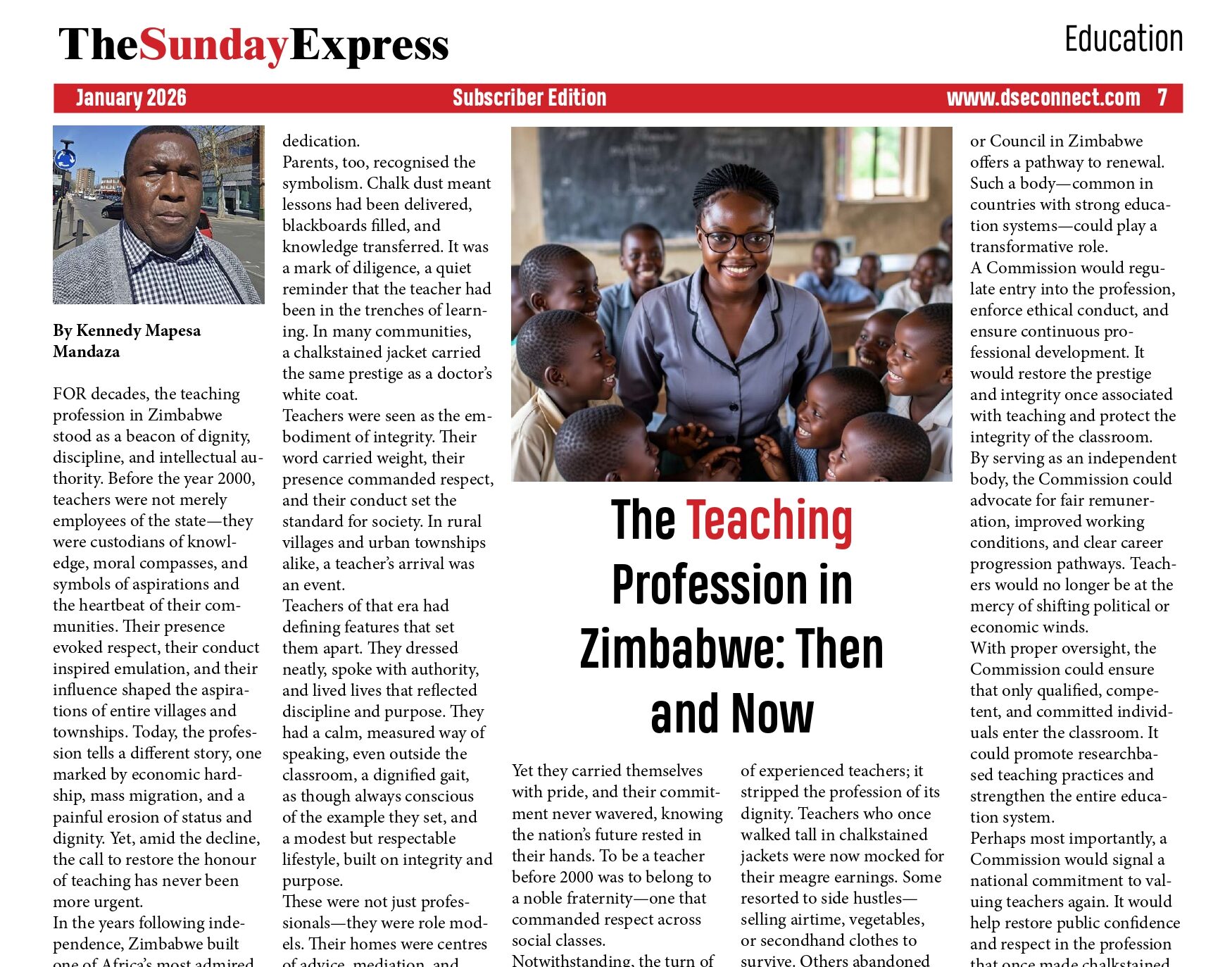
To see a teacher walking through the community with chalk dust on their jacket or trousers was to witness a badge of honour. Chalk was not dirt; it was evidence of work done, lessons delivered, of minds shaped and futures moulded. Children would whisper with admiration, “VaMapesa vakabva kuchikoro,” simply because the white smudges told a story of dedication.
Parents, too, recognised the symbolism. Chalk dust meant lessons had been delivered, blackboards filled, and knowledge transferred. It was a mark of diligence, a quiet reminder that the teacher had been in the trenches of learning. In many communities, a chalkstained jacket carried the same prestige as a doctor’s white coat.
Teachers were seen as the embodiment of integrity. Their word carried weight, their presence commanded respect, and their conduct set the standard for society. In rural villages and urban townships alike, a teacher’s arrival was an event.
Teachers of that era had defining features that set them apart. They dressed neatly, spoke with authority, and lived lives that reflected discipline and purpose. They had a calm, measured way of speaking, even outside the classroom, a dignified gait, as though always conscious of the example they set, and a modest but respectable lifestyle, built on integrity and purpose.
These were not just professionals—they were role models. Their homes were centres of advice, mediation, and community leadership. They chaired development committees, mediated disputes, guided youth clubs, and were the first port of call when families faced crises.
Parents entrusted them with shaping the future of their children, and learners aspired to emulate them. Becoming a teacher was a dream for many young Zimbabweans—a badge of honour.
Teaching was more than a job—it was a calling. Teachers often worked long hours, often marking books and preparing lessons late in the night by candlelight, running sports teams, coaching debate clubs, and offering extra lessons not for profit but for the love of seeing learners succeed.
Many walked long distances to school, taught under trees when classrooms were scarce, and improvised teaching aids from cardboard, bottle tops, and maize stalks.
Yet they carried themselves with pride, and their commitment never wavered, knowing the nation’s future rested in their hands. To be a teacher before 2000 was to belong to a noble fraternity—one that commanded respect across social classes.
Notwithstanding, the turn of the millennium brought economic turmoil that reshaped every sector of Zimbabwean life. For teachers, the impact was devastating.
As salaries collapsed and inflation spiralled, teachers found themselves unable to afford basic necessities to support their families.
The once respected professional was now struggling to buy bread or pay bus fare. Many left the country for the United Kingdom, South Africa, Botswana, and beyond, where their skills were highly valued. Zimbabwean teachers became some of the most sought after educators abroad, a testament to the strong foundation they had built at home.
But their departure left a vacuum—one that the education system has struggled to fill for more than two decades.
The economic decline did more than empty classrooms of experienced teachers; it stripped the profession of its dignity.
Teachers who once walked tall in chalkstained jackets were now mocked for their meagre earnings. Some resorted to side hustles—selling airtime, vegetables, or secondhand clothes to survive. Others abandoned the classroom altogether to join protests, a stark contrast to the disciplined, apolitical image teachers once held.
The profession that had once inspired admiration became a symbol of national decline. The teacher’s briefcase was replaced by plastic bags. The crisp trousers gave way to worn out clothing. The aura of authority faded, replaced by frustration and despair.
With experienced teachers gone and morale at rock bottom, the quality of education suffered. Schools struggled with shortages of qualified staff, overcrowded classrooms, and chronic shortages of learning materials became the new normal. The ripple effects were felt across generations, contributing to declining pass rates and widening inequalities.
Amid these challenges, the proposal to establish a Teaching Profession Commission or Council in Zimbabwe offers a pathway to renewal. Such a body—common in countries with strong education systems—could play a transformative role.
A Commission would regulate entry into the profession, enforce ethical conduct, and ensure continuous professional development. It would restore the prestige and integrity once associated with teaching and protect the integrity of the classroom.
By serving as an independent body, the Commission could advocate for fair remuneration, improved working conditions, and clear career progression pathways. Teachers would no longer be at the mercy of shifting political or economic winds.
With proper oversight, the Commission could ensure that only qualified, competent, and committed individuals enter the classroom. It could promote research based teaching practices and strengthen the entire education system.
Perhaps most importantly, a Commission would signal a national commitment to valuing teachers again. It would help restore public confidence and respect in the profession that once made chalkstained jackets a symbol of honour rather than hardship and reaffirm the central role teachers play in shaping Zimbabwe’s future.
“Restoring the honour of teaching is a national, societal imperative”
The story of the teaching profession in Zimbabwe is one of remarkable highs and painful lows. From the dignified, respected, community-anchoring and chalkmarked educators of the pre2000 era to the struggling, undervalued teachers of today, the contrast is stark. Yet the resilience of Zimbabwean teachers—those who stayed and those who left—remains a testament to their calling.
Restoring the dignity and honour of the teaching profession is not merely an act of nostalgia; it is an investment in the nation’s future. It is the restoration of the honour of education itself. And this must be done as a matter of necessity.
A nation cannot rise above the quality of its teachers. When teachers lose dignity, society loses direction. When teachers are undervalued, the future is compromised. When the profession is weakened, the entire education system collapses.
Rebuilding the teaching profession is therefore not just an educational reform—it is a national, societal imperative. It is an investment in the country’s human capital, its moral fabric, and its long term development.
Zimbabwe once led Africa in literacy and educational excellence. With deliberate action, including the establishment of a Teaching Profession Commission, it can reclaim that legacy. The chalk dust may have faded, but the honour of the profession can—and must—be restored.
Mapesa Mandaza writes to the DSE News Network in his own capacity.