DSE Football News
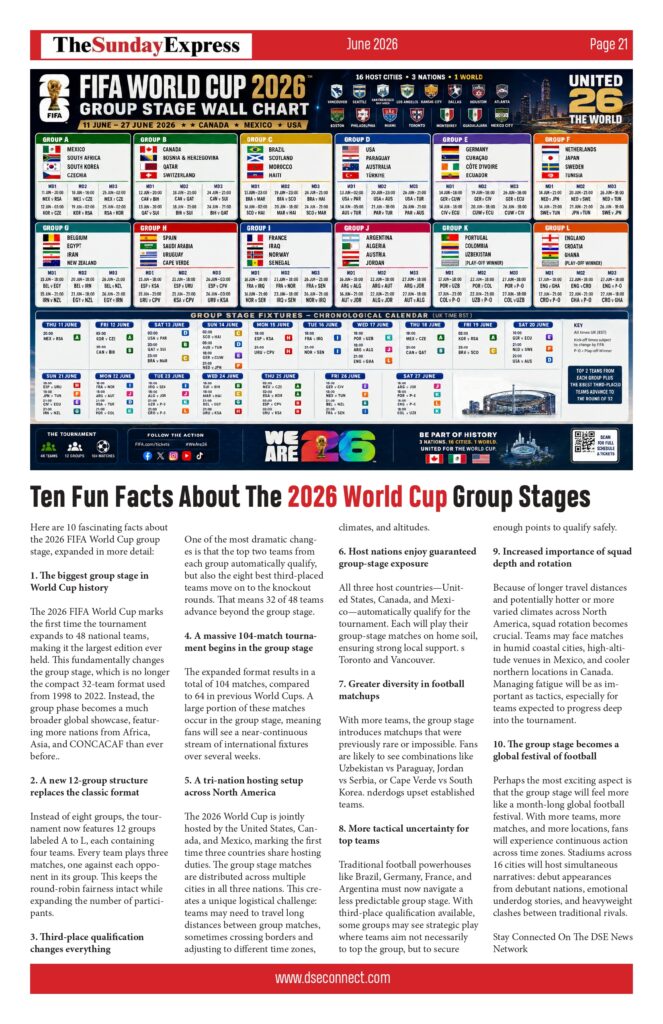
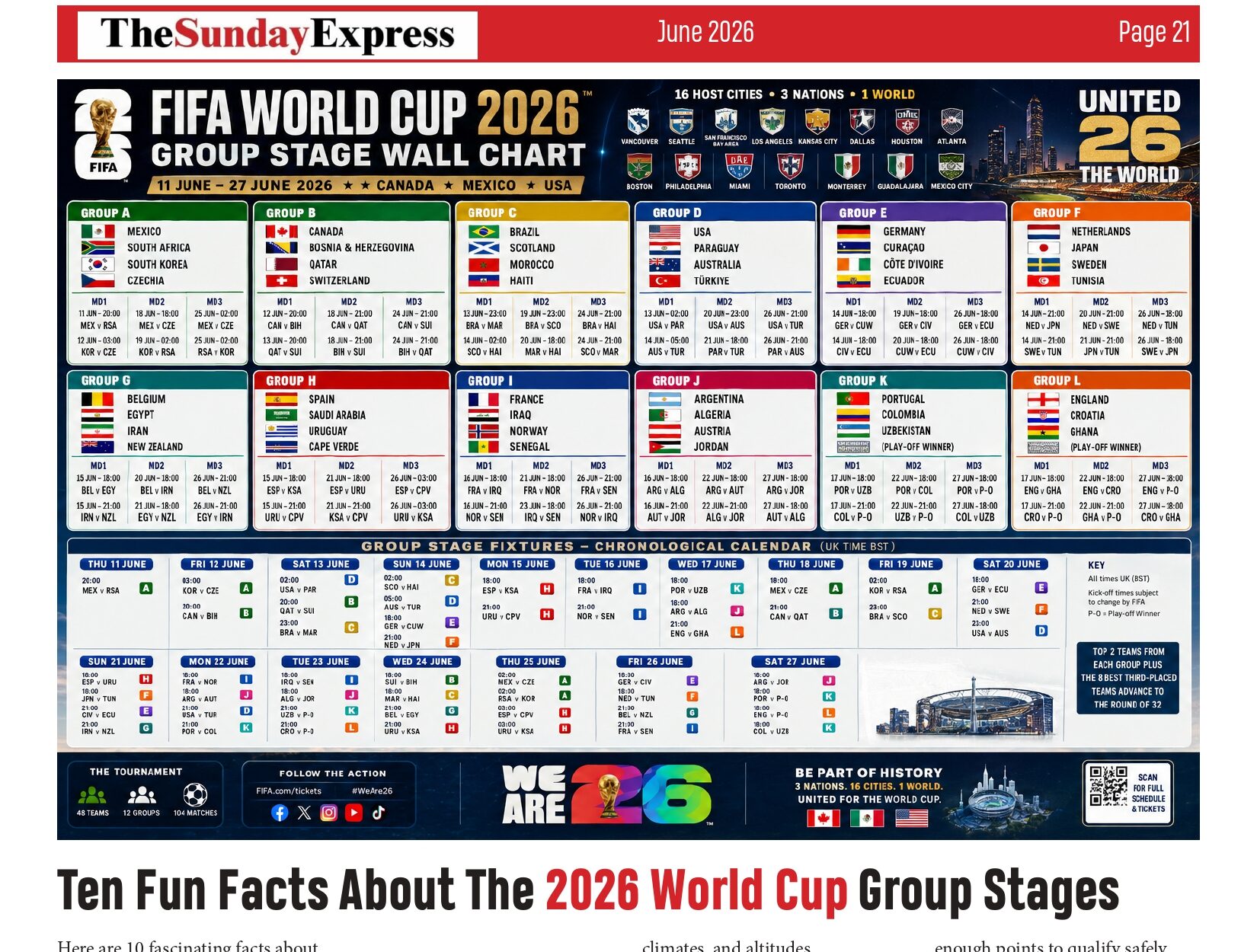
Here are 10 fascinating facts about the 2026 FIFA World Cup group stage
1. The biggest group stage in World Cup history
The 2026 FIFA World Cup marks the first time the tournament expands to 48 national teams, making it the largest edition ever held. This fundamentally changes the group stage, which is no longer the compact 32-team format used from 1998 to 2022. Instead, the group phase becomes a much broader global showcase, featuring more nations from Africa, Asia, and CONCACAF than ever before. This expansion is designed to increase global representation and give more countries a chance to compete on football’s biggest stage.
2. A new 12-group structure replaces the classic format
Instead of eight groups, the tournament now features 12 groups labeled A to L, each containing four teams. Every team plays three matches, one against each opponent in its group. This keeps the round-robin fairness intact while expanding the number of participants. However, it also introduces new strategic complexity, since finishing third in a group can still be enough to advance.
3. Third-place qualification changes everything
One of the most dramatic changes is that the top two teams from each group automatically qualify, but also the eight best third-placed teams move on to the knockout rounds. That means 32 of 48 teams advance beyond the group stage. This significantly reduces the “do-or-die” nature of early matches, as teams with mixed results still have a realistic path to survival. It also increases the importance of goal difference, fair play points, and even late-game scoring.
4. A massive 104-match tournament begins in the group stage
The expanded format results in a total of 104 matches, compared to 64 in previous World Cups. A large portion of these matches occur in the group stage, meaning fans will see a near-continuous stream of international fixtures over several weeks. This also creates scheduling challenges for broadcasters and organizers but offers unprecedented football content for global audiences.
5. A tri-nation hosting setup across North America
The 2026 World Cup is jointly hosted by the United States, Canada, and Mexico, marking the first time three countries share hosting duties. The group stage matches are distributed across multiple cities in all three nations. This creates a unique logistical challenge: teams may need to travel long distances between group matches, sometimes crossing borders and adjusting to different time zones, climates, and altitudes.
6. Host nations enjoy guaranteed group-stage exposure
All three host countries—United States, Canada, and Mexico—automatically qualify for the tournament. Each will play their group-stage matches on home soil, ensuring strong local support. The United States, with its large number of stadiums, is expected to host the majority of group matches, while Mexico brings historic venues like the Estadio Azteca, and Canada adds newer stadium infrastructure in cities such as Toronto and Vancouver.
7. Greater diversity in football matchups
With more teams, the group stage introduces matchups that were previously rare or impossible. Fans are likely to see combinations like Uzbekistan vs Paraguay, Jordan vs Serbia, or Cape Verde vs South Korea. This diversity is one of the main goals of the expansion: to give smaller football nations exposure to elite competition and global visibility. It also creates opportunities for “giant-killing” moments where underdogs upset established teams.
8. More tactical uncertainty for top teams
Traditional football powerhouses like Brazil, Germany, France, and Argentina must now navigate a less predictable group stage. With third-place qualification available, some groups may see strategic play where teams aim not necessarily to top the group, but to secure enough points to qualify safely. This could lead to more conservative tactics in certain matches, especially late in the group stage when standings are clearer.
9. Increased importance of squad depth and rotation
Because of longer travel distances and potentially hotter or more varied climates across North America, squad rotation becomes crucial. Teams may face matches in humid coastal cities, high-altitude venues in Mexico, and cooler northern locations in Canada. Managing fatigue will be as important as tactics, especially for teams expected to progress deep into the tournament.
10. The group stage becomes a global festival of football
Perhaps the most exciting aspect is that the group stage will feel more like a month-long global football festival. With more teams, more matches, and more locations, fans will experience continuous action across time zones. Stadiums across 16 cities will host simultaneous narratives: debut appearances from debutant nations, emotional underdog stories, and heavyweight clashes between traditional rivals.
Stay Connected On The DSE Football News network