DSE News Network
The Ten Outrageous Reasons Why AI Has Ruined Your Life
- As An African Your Job Is Now “Under Review” By A Robot
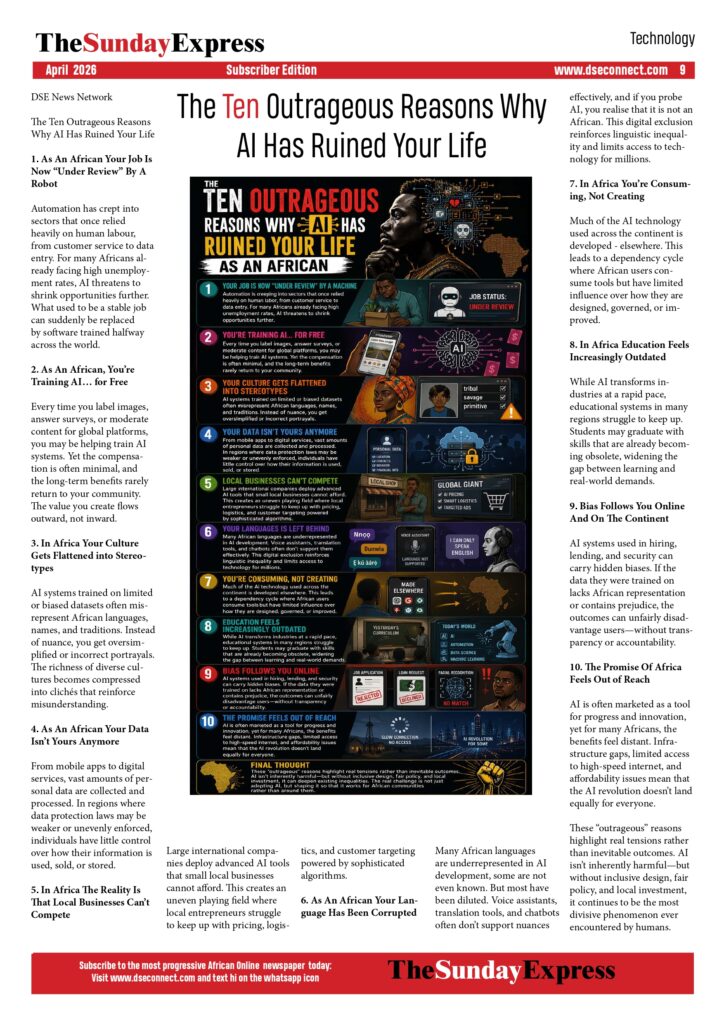
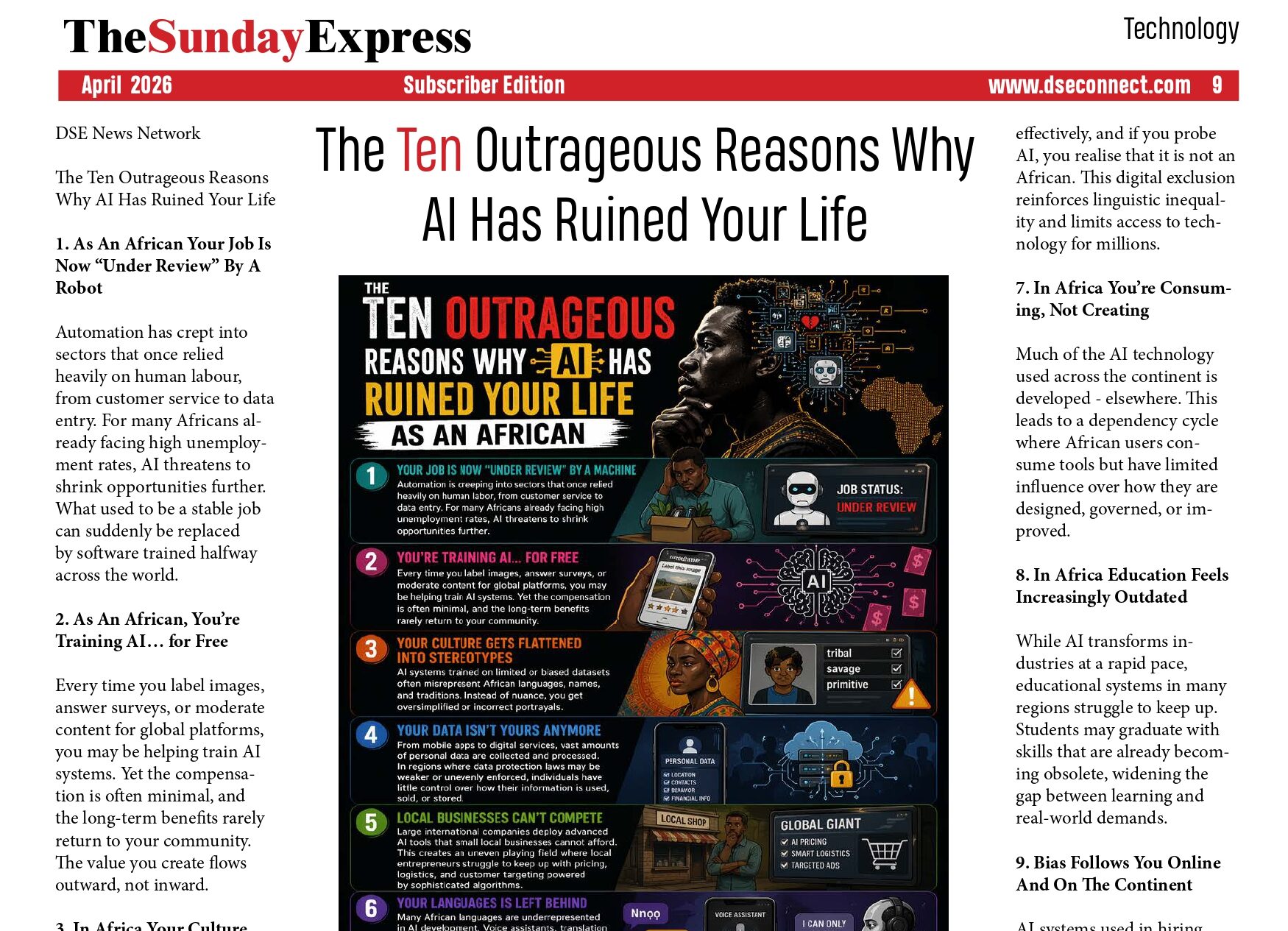
Automation has crept into sectors that once relied heavily on human labour, from customer service to data entry. For many Africans already facing high unemployment rates, AI threatens to shrink opportunities further. What used to be a stable job has suddenly been replaced by software trained halfway across the world.
- As An African, You’re Training AI… for Free
Every time you label images, answer surveys, or moderate content for global platforms, you may be helping train AI systems. Yet the compensation is often minimal, and the long-term benefits rarely return to your community. The value you create flows outward, not inward.
- In Africa Your Culture Gets Flattened into Stereotypes
AI systems trained on limited or biased datasets often misrepresent African languages, names, and traditions. Instead of nuance, you get oversimplified or incorrect portrayals. The richness of diverse cultures becomes compressed into clichés that reinforce misunderstanding.
- As An African Your Data Isn’t Yours Anymore
From mobile apps to digital services, vast amounts of personal data are collected and processed. In regions where data protection laws may be weaker or unevenly enforced, individuals have little control over how their information is used, sold, or stored.
- In Africa The Reality Is That Local Businesses Can’t Compete
Large international companies deploy advanced AI tools that small local businesses cannot afford. This creates an uneven playing field where local entrepreneurs struggle to keep up with pricing, logistics, and customer targeting powered by sophisticated algorithms.
- As An African Your Language Has Been Corrupted
Many African languages are underrepresented in AI development, some are not even known. But most have been diluted. Voice assistants, translation tools, and chatbots often don’t support nuances effectively, and if you probe AI, you realise that it is not an African. This digital exclusion reinforces linguistic inequality and limits access to technology for millions.
- In Africa You’re Consuming, Not Creating
Much of the AI technology used across the continent is developed – elsewhere. This leads to a dependency cycle where African users consume tools but have limited influence over how they are designed, governed, or improved.
- In Africa Education Feels Increasingly Outdated
While AI transforms industries at a rapid pace, educational systems in many regions struggle to keep up. Students may graduate with skills that are already becoming obsolete, widening the gap between learning and real-world demands.
- Bias Follows You Online And On The Continent
AI systems used in hiring, lending, and security can carry hidden biases. If the data they were trained on lacks African representation or contains prejudice, the outcomes can unfairly disadvantage users—without transparency or accountability.
- The Promise Of Africa Feels Out of Reach
AI is often marketed as a tool for progress and innovation, yet for many Africans, the benefits feel distant. Infrastructure gaps, limited access to high-speed internet, and affordability issues mean that the AI revolution doesn’t land equally for everyone.
These “outrageous” reasons highlight real tensions rather than inevitable outcomes. AI isn’t inherently harmful—but without inclusive design, fair policy, and local investment, it continues to be the most divisive phenomenon ever encountered by humans.
Stay Connected On The DSE News Network