By Maxwell Gomera | April 2026
Last week I was in Langa, Cape Town. There I met a young man making herbal tea – beautiful product, real market, genuine potential. Also I met a young woman running a tshisa nyama I will not forget. The flavour, the whole experience. She told me she is thinking about moving to a call centre.
I wanted to hold her by the shoulders and say: what you have built is not informal. It is a business. The system that cannot see it is the problem – not you.
And in Alexandra, I met a woman running a spaza shop. Quiet. Determined. Brilliant. She told me she produces more solar energy than she needs – so she powers the traffic lights near her business. Public infrastructure. From a spaza shop.
These are not people waiting for rescue. They are people building the future – with or without us.
They remind me of my mother. She ran a small business in Kadoma, Zimbabwe – a ledger, careful notes, customers’ names, what they owed, what they paid. She invented Know Your Customer before the banks did. She never lived to see this day.
But she taught me that entrepreneurship is not about capital or contracts. It is about showing up every day with discipline and dignity for the people counting on you. This is not a small business sector. This is the economy.
In South Africa, estimates suggest there are approximately 3 million MSMEs, employing around 13.4 million people and accounting for up to 80% of the workforce and between 40 and 50% of GDP.
In Zimbabwe, the informal and small business sector accounts for over 75% of all economic activity and close to 60% of GDP. It is, in the words of one economist, the unofficial main national economy.
In South Africa, this is the jobs crisis. In Zimbabwe, this is the economy itself.
Unemployment stands at 31.4% in South Africa – among the highest in the world – with youth unemployment at 57%. Formal employment alone will never absorb everyone who needs work and dignity. It never has. The small business is not a consolation prize. It is the engine.
This is not a character problem. It is a design problem.
We have built financial systems that require formality before opportunity. Tax systems that assume capacity before support. Markets that reward scale, not potential.
And then we ask entrepreneurs to formalise into that structure. It should not surprise us that many make the rational decision to stay informal. More costs, more compliance, more exposure – with no clear increase in opportunity on the other side.
Formalisation should feel like an upgrade. Not a trap. If we are serious about jobs and wealth creation, we need to move from programmes to platforms. From support to systems. Three shifts, made with urgency, can change the game.
Lets build credit systems that see reality, not just paperwork. Most small businesses are invisible to banks – not because they are unviable, but because they do not fit traditional credit models.
Yet every day they generate data: mobile money transactions, inventory purchases, supplier payments, customer flows. That is economic activity. That is credit intelligence.
Across Kenya, Nigeria, and parts of South Africa, alternative credit scoring is already enabling thousands of small businesses to access working capital for the first time, with some models reporting non-performing loan rates below 5%. The problem was never the entrepreneur. It was the lens.
Make compliance simple, digital, and genuinely valuable. Imagine a woman in Langa who photographs her receipts on a phone, speaks her records in her own language, and receives a compliant return within minutes.
That technology exists today. Countries like Estonia and Rwanda have shown that digital public infrastructure can transform compliance from a burden into a gateway. When compliance unlocks cheaper finance and new markets – behaviour changes. People do not resist systems that work for them.
Treat the last mile as the engine, not the edge.
M-PESA did not succeed because Kenya had the best infrastructure. It succeeded because it was designed for the user with the least – simple, accessible, built for real life. Equip spaza shops and informal traders with digital payments, inventory systems, and credit access – and they become powerful nodes in the economy. Not the edge of the system. The system itself.
A word on artificial intelligence.
AI will not change this story. Who we build it for will. The opportunity is practical: AI can help small businesses manage inventory, automate compliance, match them to finance, and provide real-time advice in local languages.
It can be the consultant, accountant, and analyst that most small business owners have never been able to afford. But built for corporates, it widens the gap. Built for a spaza shop, it closes it. That choice is ours.
My mother kept her ledger faithfully until the end. No accountant, no tax number, no system that could see her. Just discipline, integrity, and a quiet belief that what she was building mattered.
She was right.
The woman in Alexandra powering traffic lights from a spaza shop would have understood her immediately. So would the young man in Langa with tea that deserves a global market. They are all doing the same thing – building something real, with whatever the system leaves them.
The difference between my mother’s generation and theirs is not effort or ingenuity.
It is the gate.
Open it.
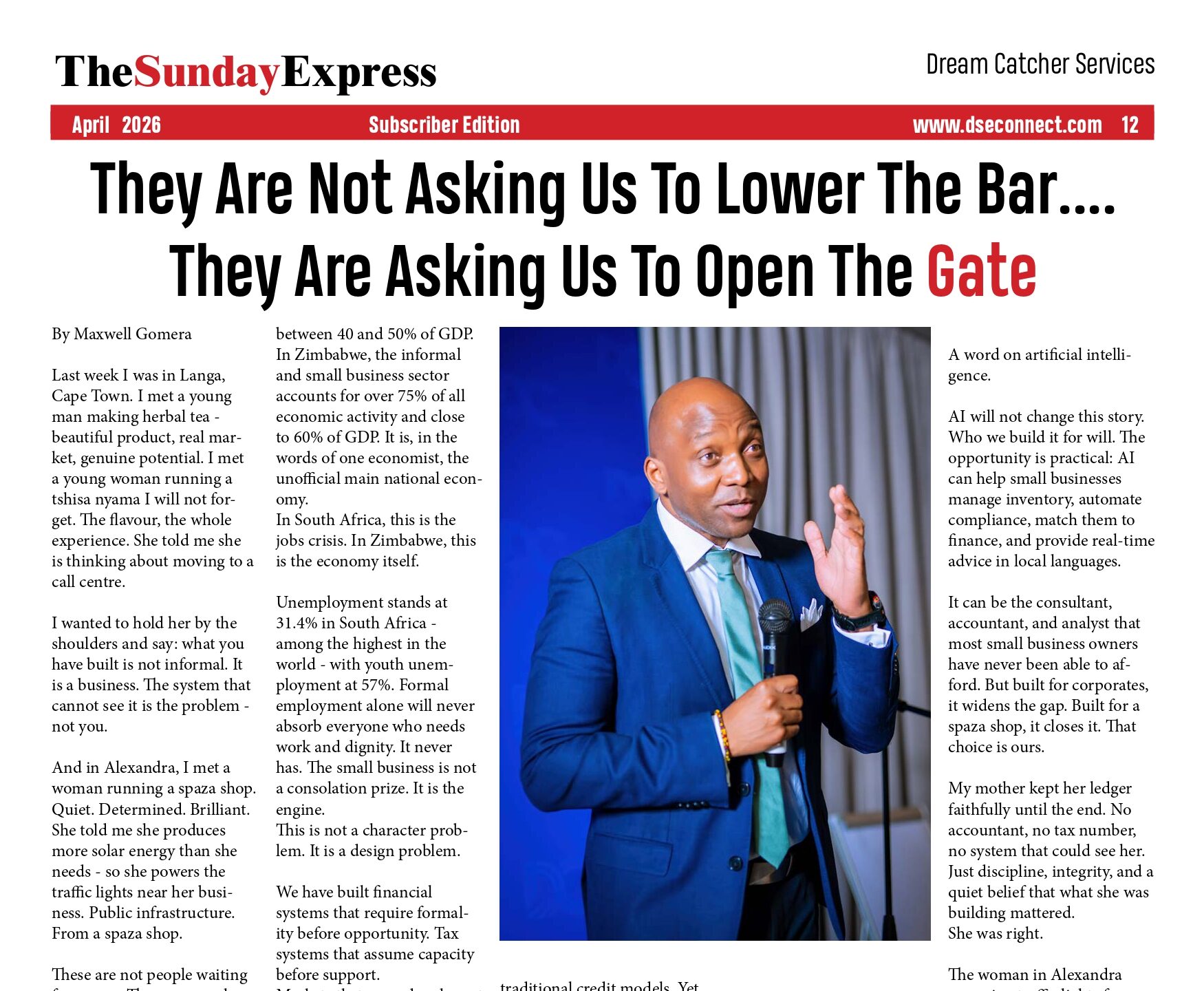
Maxwell Gomera is the UNDP Resident Representative for South Africa and Director of the Africa Sustainable Finance Hub. He writes in his personal capacity. This speech was delivered at the Dreamcatchers SMME Tax And Compliance Breakfast in Boksburg. Stay Connected on The DSE News Network