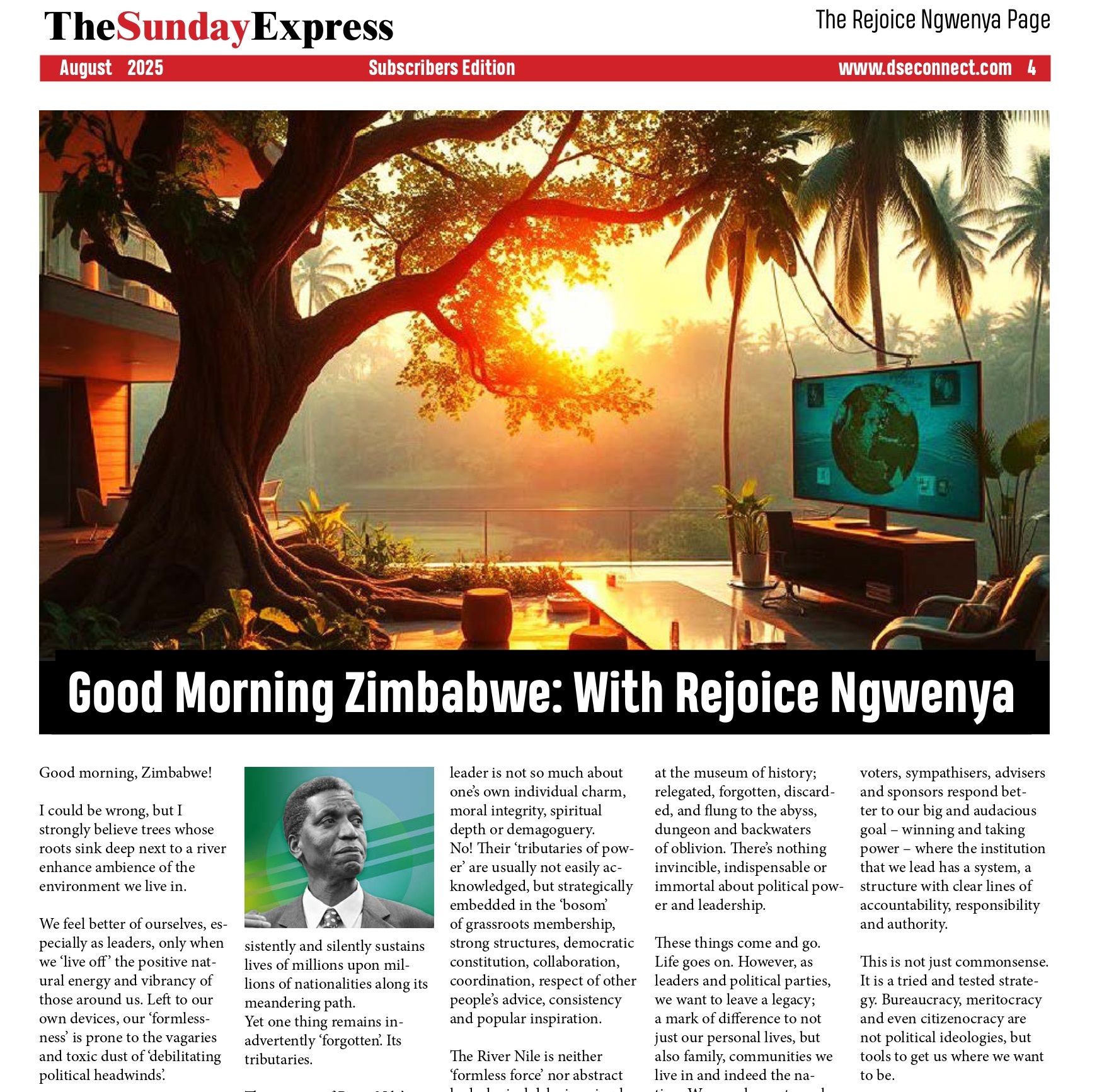
I could be wrong, but I strongly believe trees whose roots sink deep next to a river enhance ambience of the environment we live in.
We feel better of ourselves, especially as leaders, only when we ‘live off’ the positive natural energy and vibrancy of those around us.
Left to our own devices, our ‘formlessness’ is prone to the vagaries and toxic dust of ‘debilitating political headwinds’.
Tributaries Of Power
In Tributaries of Power – #MyThougths – I said that: One of, if not the greatest hydrological phenomena on Planet Earth is River Nile. Its strength and majesty lie not so much as in length than it being a harbinger and frontier of human civilisation.
If you, like I, studied African History know how, for eons, River Nile effortlessly, consistently and silently sustains lives of millions upon millions of nationalities along its meandering path. Yet one thing remains inadvertently ‘forgotten’. Its tributaries.
The sources of River Nile’s greatness are the bosom of Lake Victoria in East Africa and the highlands of Ethiopia – thousands of miles away from its blissful paradise of the Mediterranean Sea. In contemporary marketing parlance, I would say “River Nile is made in Kampala, Adis Ababa and delivered to Cairo .”
And that is how real political power is structured. The greatness of a political party leader is not so much about one’s own individual charm, moral integrity, spiritual depth or demagoguery. No! Their ‘tributaries of power’ are usually not easily acknowledged, but strategically embedded in the ‘bosom’ of grassroots membership, strong structures, democratic constitution, collaboration, coordination, respect of other people’s advice, consistency and popular inspiration.
The River Nile is neither ‘formless force’ nor abstract hydrological delusion simply pampering citizens along its shores with populist might. Its strength, grace, visibility and umbilical essence are known, identifiable factors.
Tried And Tested
The other week, on #TriedAndTestedStructure – I wrote that it is easy for a once iconic political party – even a once adored leader – to evaporate in the mist of time, fossilised at the museum of history; relegated, forgotten, discarded, and flung to the abyss, dungeon and backwaters of oblivion. There’s nothing invincible, indispensable or immortal about political power and leadership.
These things come and go. Life goes on. However, as leaders and political parties, we want to leave a legacy; a mark of difference to not just our personal lives, but also family, communities we live in and indeed the nation. We can choose to make these ‘footprints of novelty’ as individuals, local or nation leaders.
And when we take the national leadership path, other than leveraging our personal charisma, we have to collaborate with others – using a system, a structure and an institution with clear lines of accountability, responsibility and authority.
Our followers, supporters, voters, sympathisers, advisers and sponsors respond better to our big and audacious goal – winning and taking power – where the institution that we lead has a system, a structure with clear lines of accountability, responsibility and authority.
This is not just commonsense. It is a tried and tested strategy. Bureaucracy, meritocracy and even citizenocracy are not political ideologies, but tools to get us where we want to be.
Yet these tools only excel in a system, a structure and an institution with clear lines of accountability, responsibility and authority. Otherwise we are destined to the museum of time.
Rejoice Ngwenya Writes From Ruwa. The Views Expressed Are His Alone, And Do Not Necessarily Reflect The Editorial Position Of The Sunday Express And The DSE News Network