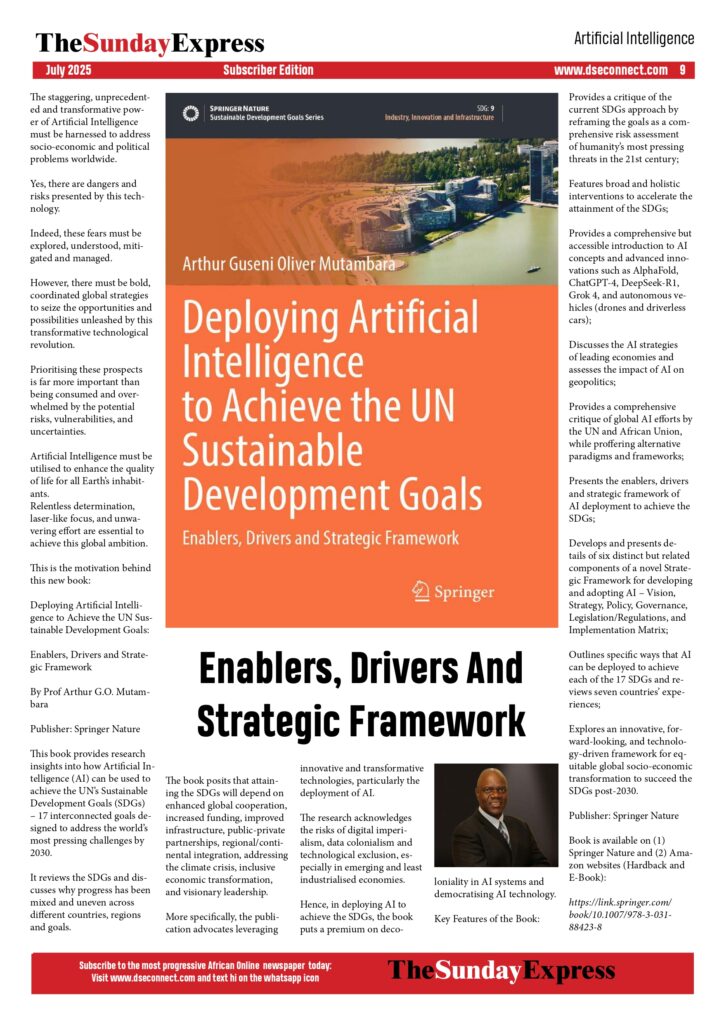
By Prof Arthur G.O. Mutambara, Publisher: Springer Nature
The staggering, unprecedented and transformative power of Artificial Intelligence must be harnessed to address socio-economic and political problems worldwide.
Yes, there are dangers and risks presented by this technology.
Indeed, these fears must be explored, understood, mitigated and managed.
However, there must be bold, coordinated global strategies to seize the opportunities and possibilities unleashed by this transformative technological revolution.
Prioritising these prospects is far more important than being consumed and overwhelmed by the potential risks, vulnerabilities, and uncertainties.
Artificial Intelligence must be utilised to enhance the quality of life for all Earth’s inhabitants.
Relentless determination, laser-like focus, and unwavering effort are essential to achieve this global ambition.
This is the motivation behind this new book: Deploying Artificial Intelligence to Achieve the UN Sustainable Development Goals: Enablers, Drivers and Strategic Framework
This book provides research insights into how Artificial Intelligence (AI) can be used to achieve the UN’s Sustainable Development Goals (SDGs) – 17 interconnected goals designed to address the world’s most pressing challenges by 2030.
It reviews the SDGs and discusses why progress has been mixed and uneven across different countries, regions and goals.
The book posits that attaining the SDGs will depend on enhanced global cooperation, increased funding, improved infrastructure, public-private partnerships, regional/continental integration, addressing the climate crisis, inclusive economic transformation, and visionary leadership.
More specifically, the publication advocates leveraging innovative and transformative technologies, particularly the deployment of AI.
The research acknowledges the risks of digital imperialism, data colonialism and technological exclusion, especially in emerging and least industrialised economies.
Hence, in deploying AI to achieve the SDGs, the book puts a premium on decoloniality in AI systems and democratising AI technology.
Key Features of the Book:
Provides a critique of the current SDGs approach by reframing the goals as a comprehensive risk assessment of humanity’s most pressing threats in the 21st century;
Features broad and holistic interventions to accelerate the attainment of the SDGs;
Provides a comprehensive but accessible introduction to AI concepts and advanced innovations such as AlphaFold, ChatGPT-4, DeepSeek-R1, Grok 4, and autonomous vehicles (drones and driverless cars);
Discusses the AI strategies of leading economies and assesses the impact of AI on geopolitics;
Provides a comprehensive critique of global AI efforts by the UN and African Union, while proffering alternative paradigms and frameworks;
Presents the enablers, drivers and strategic framework of AI deployment to achieve the SDGs;
Develops and presents details of six distinct but related components of a novel Strategic Framework for developing and adopting AI – Vision, Strategy, Policy, Governance, Legislation/Regulations, and Implementation Matrix;
Outlines specific ways that AI can be deployed to achieve each of the 17 SDGs and reviews seven countries’ experiences;
Explores an innovative, forward-looking, and technology-driven framework for equitable global socio-economic transformation to succeed the SDGs post-2030.
Publisher: Springer Nature
Book is available on (1) Springer Nature and (2) Amazon websites (Hardback and E-Book):